
A nearby patient searches for a dentist on their phone, compares the local results, scans reviews, checks whether the practice looks trustworthy, and opens the website to see how quickly they can request an appointment. A practice can rank well and still lose that patient if its Google Business Profile is incomplete, its mobile page is difficult to use, or its service information doesn't answer the questions that matter.
Effective dental SEO strategies support every step of that decision. They connect treatment pages with patient intent, make the practice visible in Google Search and Maps, establish trust through reviews and useful content, remove technical barriers, and show which visibility turns into qualified inquiries. The eight approaches below are arranged as a connected growth system, beginning with services and local discovery, then moving through content, technical health, authority, reputation, intent mapping, and multi-channel consistency.
Table of Contents
- 1. Local SEO Optimization for Dental Practices
- 2. Keyword Research and Strategic Targeting for Dental Services
- 3. High-Quality Content Creation and Dental Topic Clustering
- 4. Technical SEO and Website Performance Optimization
- 5. Authority Building Through Strategic Link Acquisition
- 6. Review Management and Reputation Monitoring
- 7. Search Intent Optimization and Patient Journey Content Mapping
- 8. Multi-Channel Local Presence and Citation Consistency
- 8-Point Dental SEO Strategy Comparison
- Turn Dental SEO Into a Practice Growth System
1. Local SEO Optimization for Dental Practices
Local SEO gives a dental practice its clearest route to nearby patients. A complete Google Business Profile, accurate contact details, service information, appointment links, current photos, and well-managed reviews help Google understand what the practice offers and where it serves patients. Google explains local ranking through relevance, distance, and prominence, so adding a city name to a page won't compensate for an incomplete profile or weak evidence of the services patients are searching for. Google's local ranking guidance also notes that reviews and positive ratings can contribute to prominence.
Local intent matters because people often search for nearby providers rather than navigating directly to a practice website. Industry healthcare compilations report that approximately 46% of Google searches have local intent, while about 88% of consumers who conduct a local search on a smartphone visit or call a related physical business within 24 hours. Those figures apply to local search broadly, not dentistry alone, but they explain why map visibility and a fast booking path deserve as much attention as organic rankings. Healthcare local-search data supports treating local optimization as an acquisition channel, not a profile-maintenance task.
Build a location and service connection
Start by making the profile accurate and specific. Choose appropriate categories, list genuine treatments, add appointment URLs, verify opening hours, and use real photographs of the office and team. Then align the website with the profile through a useful location page and dedicated service pages for treatments such as implants, emergency dentistry, Invisalign, and pediatric care.
A practice with one office needs one strong local entity. A multi-location group needs separate, accurate listings and useful location pages. Keep the business name, address, and phone number consistent across the website, directories, and social profiles. This guide to optimizing a Google Business Profile provides a practical reference for profile improvements.
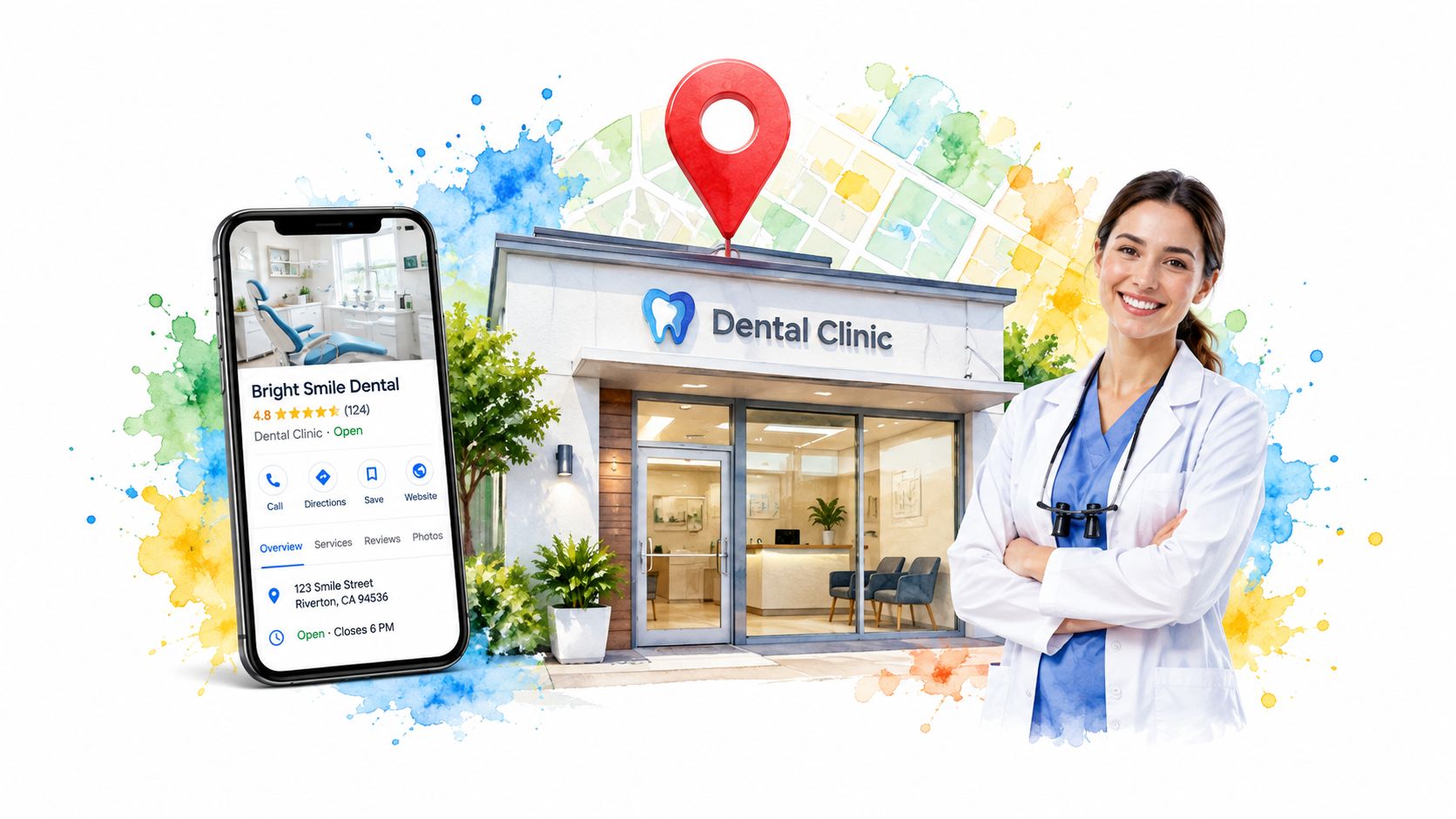
Monitor Business Profile calls, direction requests, website visits, appointment interactions, local rankings, and review themes separately from organic clicks. A local page that attracts fewer visits but more qualified appointment requests may be doing better than a broad blog post with higher traffic. Practices that want an outside perspective can also review Boise marketing support from Leaping Lemur Media as an example of a local-service marketing resource.
2. Keyword Research and Strategic Targeting for Dental Services
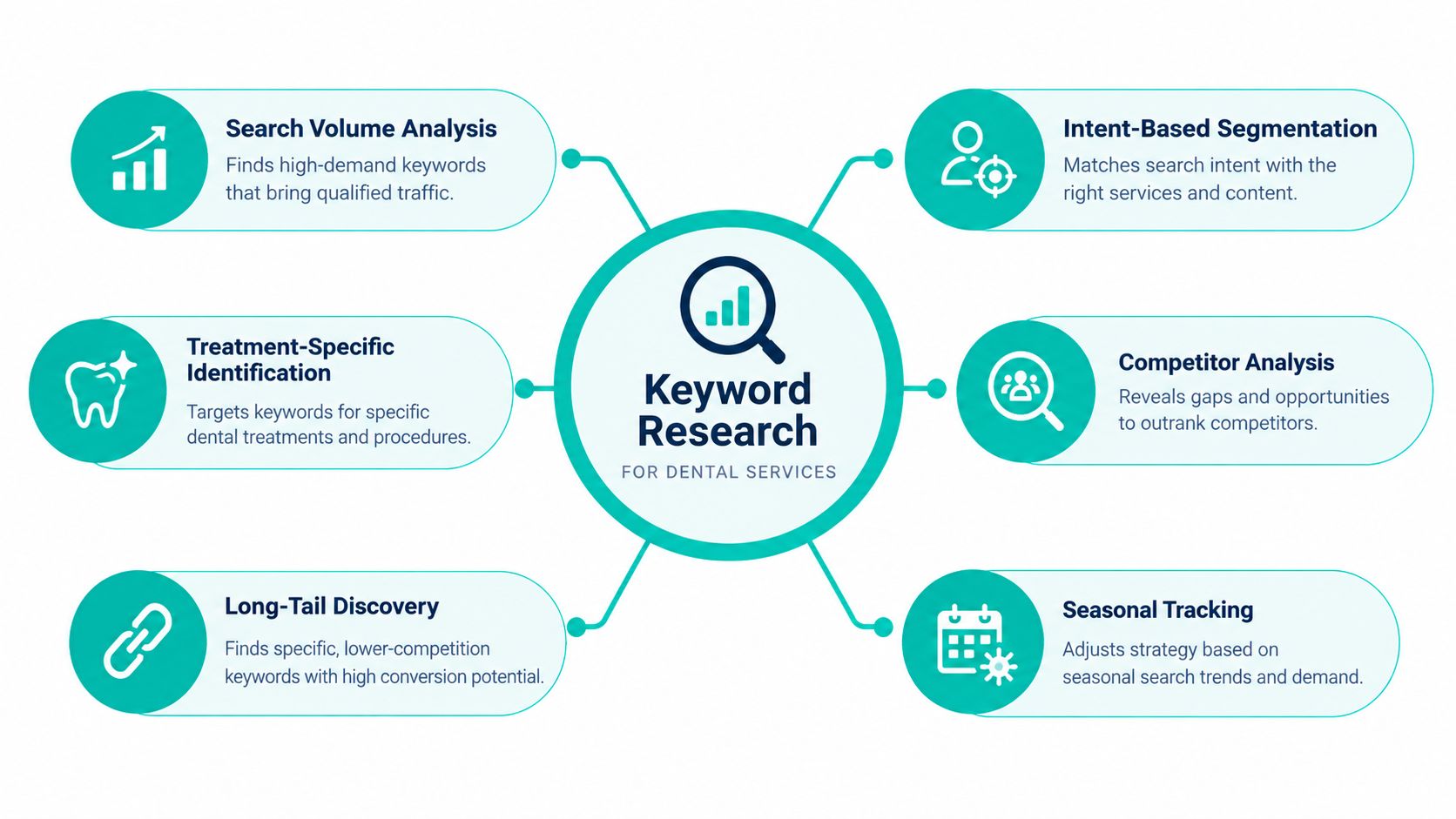
Keyword research should begin with the treatments the practice wants to grow, not with a large list of phrases copied from a software export. A general dentist might need separate research for emergency care, preventive visits, children's dentistry, crowns, and cosmetic treatments. An implant provider has different patient questions and conversion paths from an orthodontist, even when both compete in the same city.
The useful distinction is search intent. “Dentist near me” suggests a provider search. “How long does a root canal take?” indicates education. “Dental implants cost” often signals comparison and planning. “Emergency dentist open now” communicates urgency. Each query deserves a page that matches the decision the searcher is trying to make, rather than a generic services page that mentions every treatment.
Build keyword groups around real services
Create a separate keyword set for each service line, then add location modifiers such as the city, neighborhood, or “near me” phrasing where appropriate. Use Google Search Console to find queries the practice already appears for, and use Ahrefs or Semrush to study competitor page topics and gaps. This explanation of SEO keyword types can help teams distinguish broad, long-tail, branded, local, and intent-led terms.
A practical workflow looks like this:
- Start with service seeds: List the treatments, patient problems, and appointment types the practice handles.
- Add patient language: Include phrases related to pain, timing, insurance, financing, anxiety, recovery, and treatment suitability.
- Separate intent levels: Keep awareness, consideration, and decision queries in different groups so they don't all point to the same page.
- Assign one primary purpose: Give each page a clear job, such as explaining a treatment, comparing options, or generating a consultation.
- Review actual performance: Check impressions, clicks, engaged visits, calls, and appointment starts rather than assuming the highest-volume term is the best opportunity.
Don't build pages for treatments the practice doesn't offer or locations it doesn't serve. That may create temporary keyword coverage, but it weakens patient trust and gives the team more content to maintain without improving the appointment experience. Local relevance should come from genuine service availability and community knowledge, not city-name repetition.
3. High-Quality Content Creation and Dental Topic Clustering
A dental website needs content that does more than define procedures. Patients want to know what a treatment involves, who it may suit, what preparation looks like, what questions to ask, and how to take the next step with the particular practice. Topic clustering helps organize that information so a core service page can connect to supporting resources without turning the blog into a disconnected archive.
Build a pillar page for each major service, such as dental implants, orthodontics, teeth whitening, or emergency dentistry. Supporting pages can address treatment timelines, preparation, costs and insurance questions, maintenance, alternatives, recovery, and common concerns. The internal links should guide readers from general education to a relevant service page and then to contact or booking options.
Make clinical content locally useful
Generic procedure content is easy to produce and easy for a patient to ignore. A stronger page explains how the practice approaches consultations, what patients can expect before requesting an appointment, whether accessibility accommodations are available, what languages the team supports, and how the office handles urgent inquiries. These details create authentic community positioning without making unsupported medical promises.
Google treats health information as a high-stakes area. Its documentation on AI features in Google Search emphasizes that AI Overviews help users understand complicated questions before exploring linked sources. Dental content should therefore be clear enough to answer directly, clinically responsible, reviewed by an appropriate professional, dated, and explicit about the difference between general education and individualized medical advice.
Practical rule: If a page could describe any dental office, it hasn't yet explained why a patient should trust this one.
Use concise answers for common questions, clear H2 and H3 headings, accessible images, captions and transcripts for video, clinician credentials, treatment limitations, and realistic next steps. Review content regularly when clinical guidance or practice details change. Dental marketing resources from Leaping Lemur Media can also serve as a starting point for aligning a practice's story with its patient audience.
4. Technical SEO and Website Performance Optimization
Technical SEO determines whether the useful work on a dental website can be crawled, understood, and experienced without friction. A patient may arrive from Google Maps, an organic result, a review platform, or a social post. If the page loads poorly on a phone, hides the phone number, or makes the booking form difficult to complete, the practice loses value even when the page ranks.
Start with the basics. Confirm that the site uses HTTPS, pages render well on mobile devices, important content is accessible to search engines, and the XML sitemap includes key pages. Review Google Search Console for crawl errors, indexing problems, manual actions, and search performance. Use PageSpeed Insights and Core Web Vitals to identify heavy images, blocking scripts, layout shifts, and other issues that affect usability.
Use structured data accurately
LocalBusiness structured data can help Google interpret practice information, but it isn't a guaranteed ranking shortcut. Google's LocalBusiness structured-data documentation recommends adding the required properties, following the guidelines, validating the markup with the Rich Results Test, and checking how Google sees the page with URL Inspection. Pages must be accessible and can't be blocked by robots.txt, a noindex directive, or login requirements if they are expected to qualify for eligible results.
Deploy schema on a small group of relevant practice or location pages first. Use accurate, page-relevant information rather than copying one markup block across unrelated treatment pages. A dentist with several offices should make each location page distinct, with its correct address, hours, phone number, and services.
Make the appointment path obvious
A mobile visitor shouldn't have to search for the next step. Put a readable phone number, click-to-call control, booking button, address, parking guidance, and urgent-care instructions where they can be found quickly. Link service pages to the appropriate consultation page, and make forms short enough to complete without unnecessary friction.
Don't promise a performance lift from a technical change before measuring it. Compare organic engagement, mobile calls, form starts, completed bookings, and page-level conversion behavior before and after fixes. Practices reviewing their broader digital foundation can explore Leaping Lemur Media's services for related marketing and website support.
5. Authority Building Through Strategic Link Acquisition
Links matter most when they confirm something real about the practice. A link from a relevant dental association, local health organization, school, community group, or news outlet can reinforce both topical and geographic credibility. A large collection of unrelated directory links, spun guest posts, or paid placements may create noise rather than authority.
Think in terms of relationship-led visibility. A pediatric practice might collaborate with a local school on oral-health education and earn a mention on the school's community resources page. A family practice could contribute an evidence-based article to a neighborhood publication. A cosmetic dentist might support a local event and become part of its online sponsor or news coverage. The link is useful because the relationship is useful first.
Create assets worth referencing
A strong linkable asset answers a question another organization would be comfortable sending its audience to. Examples include an accessible guide to preparing children for a first visit, a plain-language emergency triage resource, a community dental-services directory, or a clinician-reviewed explanation of treatment options. These resources should identify the practice without turning every paragraph into a sales pitch.
This overview of backlink-building sites can help with prospecting, but quality control remains the practice's responsibility. Check whether a prospective site is relevant, editorially credible, and genuinely connected to the community or topic. Don't pay for a link merely because a vendor promises rankings, and don't publish medical content outside the practice's expertise.
A useful question is, “Would this organization still want to reference the resource if the link carried no SEO value?”
Monitor new links, lost links, referring domains, anchor text, and the quality of the pages linking to the practice. Pursue professional memberships and legitimate directories, but don't treat directory volume as a substitute for community authority. One credible relationship can support brand recognition, referrals, and local trust in ways a long list of low-value placements can't.
6. Review Management and Reputation Monitoring
Reviews influence both discovery and patient confidence, but a review process must protect privacy and reflect actual patient experiences. BrightLocal's 2025 Local Consumer Review Survey used a representative panel of 1,026 U.S. adult consumers, providing a concrete basis for treating reviews as a measurable local-search and trust asset rather than an informal extra. Google also identifies review count and positive ratings as signals that can contribute to local prominence. The survey methodology and findings should be read as consumer research, not as proof that a particular review total guarantees a ranking position.
Ask genuine patients for feedback after appropriate interactions, using a process that feels personal rather than automated and impersonal. The request can direct patients to the relevant platform, but the practice shouldn't pressure people to leave only positive feedback, offer improper incentives, or create reviews that aren't authentic. A steady operating process is more defensible than a sudden campaign aimed at changing the rating.
Respond without exposing patient information
Reply to positive reviews with appreciation and a specific acknowledgment of the feedback when appropriate. For a negative review, recognize the concern, avoid arguing publicly, and offer a private route for resolution. Staff shouldn't confirm that the reviewer is a patient or disclose treatment details, even when the reviewer has shared those details publicly.
Track the themes behind reviews, not just the star rating. Repeated comments about appointment timing, unclear billing, waiting-room communication, accessibility, or difficulty reaching the office may reveal operational issues that affect both reputation and conversion. Those themes can also inform service-page FAQs, provided the resulting medical information is accurate.

BrightLocal reports that 75% of consumers use more than one channel during a local-business search and that 72% examine three or fewer businesses before deciding. It also reports that more than three-quarters of U.S. consumers consume video when seeking information about local businesses. Its research on local search behavior across channels supports a coordinated approach, where reviews, website pages, video, and profile information tell the same story.
Measure review volume and sentiment alongside qualified calls, booked consultations, map actions, and treatment-line inquiries. A review management system should improve the patient experience as well as the search presence.
7. Search Intent Optimization and Patient Journey Content Mapping
A patient searching for preventive-care information doesn't need the same page as someone searching for an emergency dentist open now. Search intent optimization gives each query a useful destination and gives the practice a way to move patients from education to a confident next step without forcing every visitor into an appointment pitch.
Map content across the patient journey. Awareness pages can explain why preventive care matters or what symptoms may warrant professional evaluation. Consideration pages can compare treatment options, address cost and insurance questions, explain preparation, and clarify what a consultation includes. Decision pages should make it easy to confirm location, availability, credentials, payment information, and booking options.
Match the page to the decision
Study the pages already ranking for a target query. Their format, depth, local signals, and calls to action provide clues about what searchers expect, but the practice still needs to add information competitors don't offer. A cost page should explain what can affect an individual treatment plan without pretending to provide a universal quote. An emergency page should distinguish urgent situations from general education and tell visitors how to contact the practice.
AI search adds another reason to separate educational performance from local acquisition. A recent healthcare-search analysis reported that AI Overviews appeared for nearly all treatment and procedure queries by late 2025, while provider-intent searches such as “pediatric dentist near me” reportedly had 0% AI Overview presence in that analysis. The healthcare AI search analysis describes a strategic gap, though its findings should be treated as time-specific observations rather than a permanent rule.
This means a procedure guide may need to earn trust, branded searches, assisted conversions, and citations in search answers, not only clicks. A local service page still needs to compete for conventional local visibility, map actions, calls, and appointment starts. Don't choose between clinical education and local pages. Use authoritative education to support discovery, then make the provider and location pages compelling for patients ready to act.
Use internal links deliberately:
- Awareness to consideration: Link symptom and education pages to relevant treatment explanations.
- Consideration to decision: Link comparisons and preparation guides to consultation pages.
- Decision to action: Keep booking, click-to-call, directions, and availability information visible.
- Measurement to improvement: Use Search Console and analytics to find pages that receive attention but fail to generate useful next steps.
8. Multi-Channel Local Presence and Citation Consistency
Patients may discover a practice through Google Search, Google Maps, a review platform, a dental directory, social media, or a recommendation from a community organization. Each profile is part of the practice's public identity. If the phone number, address, hours, name, or services differ between platforms, patients may hesitate and search engines may have more difficulty connecting those references to one entity.
Create a source-of-truth document for the practice name, address formatting, phone number, hours, booking URL, clinician names, services, accessibility information, and brand imagery. Use it whenever a profile is created or updated. Claim the most relevant listings first, then review less prominent directories for duplicates, outdated information, or profiles controlled by former staff.
Coordinate profiles instead of duplicating posts
Social media isn't a replacement for local SEO, but it can show how the practice participates in its community. Share office updates, educational videos, staff introductions, patient resources with permission, and community involvement. Keep the local context specific and useful. A practice serving families might explain appointment preparation for children, while an orthodontic office could answer common questions about consultations and ongoing support.
Use consistent logos, colors, photography, descriptions, and contact information, but don't copy identical text everywhere. Each channel has a different role. Google Business Profile should make discovery and action easy. A review platform should provide independent trust signals. Instagram may demonstrate the practice environment and visual work. A community group may support conversation and referrals.
Consistency is not sameness. The facts should match across channels, while the content should fit the people using each channel.
Check profiles on a recurring schedule, especially after a move, phone change, rebrand, new clinician, or change in appointment process. Monitor reviews and messages across platforms, not only Google. Record which channels generate profile views, referral visits, calls, appointment starts, and branded searches.
8-Point Dental SEO Strategy Comparison
| Strategy | 🔄 Implementation Complexity | ⚡ Resource Requirements | 📊 Expected Outcomes | 💡 Ideal Use Cases | ⭐ Key Advantages |
|---|---|---|---|---|---|
| Local SEO Optimization for Dental Practices | Moderate, ongoing management and monitoring | Low–Medium, GBP setup, citations, review ops | Faster local visibility; ~30–50% local visibility gain in 6 months | Single or multi-location practices seeking nearby appointment growth | High local intent; increases foot traffic and bookings |
| Keyword Research & Strategic Targeting | Low–Medium, initial research then periodic updates | Low, SEO tools (Ahrefs/SEMrush) and analyst time | Improved content relevance; ~20–40% rankings for targeted keywords | Practices optimizing content, PPC, or service pages | Targets high-converting terms; data-driven content focus |
| High‑Quality Content Creation & Topic Clustering | High, planning, production, and internal linking | High, writers, subject experts, multimedia resources | Significant organic traffic gains; 50–100% in targeted topics | Practices building authority, patient education hubs, long-term growth | Builds E‑E‑A‑T and multiple keyword coverage |
| Technical SEO & Website Performance Optimization | Medium–High, audits and developer fixes | Medium, developer time, performance tools | Better UX; 5–15% ranking lift; 20–30% UX metric improvement | Sites with slow/mobile issues, migrations, or crawl problems | Foundation for SEO; improves crawlability, speed, and indexing |
| Authority Building (Strategic Link Acquisition) | High, outreach, PR, and relationship building | Medium–High, content assets and outreach effort | Domain authority growth; ~15–30% organic rankings uplift over 6+ months | Practices seeking broader credibility and editorial coverage | Strong, long‑lasting ranking signal; drives referral traffic |
| Review Management & Reputation Monitoring | Low–Medium, processes and consistent responses | Low, reputation tools and staff time | Improves local rankings & CTR; 20–40% increase in inquiries | Practices needing trust improvement and conversion lift | Direct trust signal; boosts conversions and patient confidence |
| Search Intent Optimization & Patient Journey Mapping | Medium, audit and content alignment across stages | Medium, analytics, content adjustments, CRO work | Higher conversion rates; ~25–50% improvement in conversions | Practices focused on converting searchers into booked patients | Matches patient needs; reduces bounce and improves ROI |
| Multi‑Channel Local Presence & Citation Consistency | Medium, claim and sync profiles across platforms | Medium, listing tools, staff for maintenance | Increased multi‑platform visibility; ~20–40% local visibility gain | Practices wanting comprehensive local reach and social engagement | Consistent NAP; multiple discovery touchpoints and social proof |
Turn Dental SEO Into a Practice Growth System
Dental SEO works best when the practice treats it as an operating system for discovery and trust, not as a collection of isolated ranking tasks. Start with the services that matter to the practice and the patient problems those services solve. Audit whether each priority service has a clear page, whether the page matches the likely search intent, and whether the next step is obvious on mobile. Then review local visibility through Google Business Profile, Maps, citations, reviews, location pages, and appointment paths.
Fix technical barriers before adding a large volume of content. A website that loads slowly, obscures its phone number, blocks important pages from crawling, or sends visitors through a confusing booking journey won't make good use of new traffic. Validate structured data, check indexation, simplify internal linking, improve image handling, and test the experience on the devices patients use.
Next, build a useful content system. Create authoritative service pages and supporting topic clusters that answer clinical and practical questions without overstating outcomes. Include clinician review, dates, sources, limitations, accessibility information, financing or insurance guidance where accurate, and clear distinctions between general education and individualized care. The strongest local content often explains how the practice serves its community, including language availability, anxiety accommodations, transportation guidance, emergency communication, and what a new patient can expect.
Trust signals need ongoing attention. Invite genuine reviews through a compliant process, respond without exposing protected health information, and use recurring feedback to improve both patient experience and content. Keep citations and provider details consistent across relevant directories and social platforms. Then earn authority through relationships with local organizations, professional associations, schools, community groups, and credible publications. Links gained through real expertise and participation are more useful than indiscriminate link volume.
Measurement should connect visibility to practice outcomes. Track organic clicks separately from Business Profile actions such as calls, direction requests, website visits, and appointment interactions. Review qualified inquiries, consultation starts, completed bookings, treatment-line interest, branded searches, review sentiment, and assisted conversions from educational content. A high-traffic article that never supports a useful patient action may deserve less investment than a smaller local page that consistently helps people choose the practice.
Leaping Lemur Media is relevant for practices that want local SEO, Google Business Profile optimization, citation consistency, location and procedure pages, technical audits, keyword strategy, review generation, rank tracking, and multi-location support shaped around the practice's voice. The right partner shouldn't flatten every dental office into the same template. It should listen to how the practice serves people, then turn that knowledge into pages, profiles, and measurement that help the community find, trust, and choose the team.
Leaping Lemur Media offers dental-practice marketing support across local SEO, Google Business Profile optimization, citation consistency, service pages, technical improvements, content strategy, and review generation. Visit Leaping Lemur Media to explore a community-rooted approach and discuss how your practice can turn search visibility into more useful patient connections.