
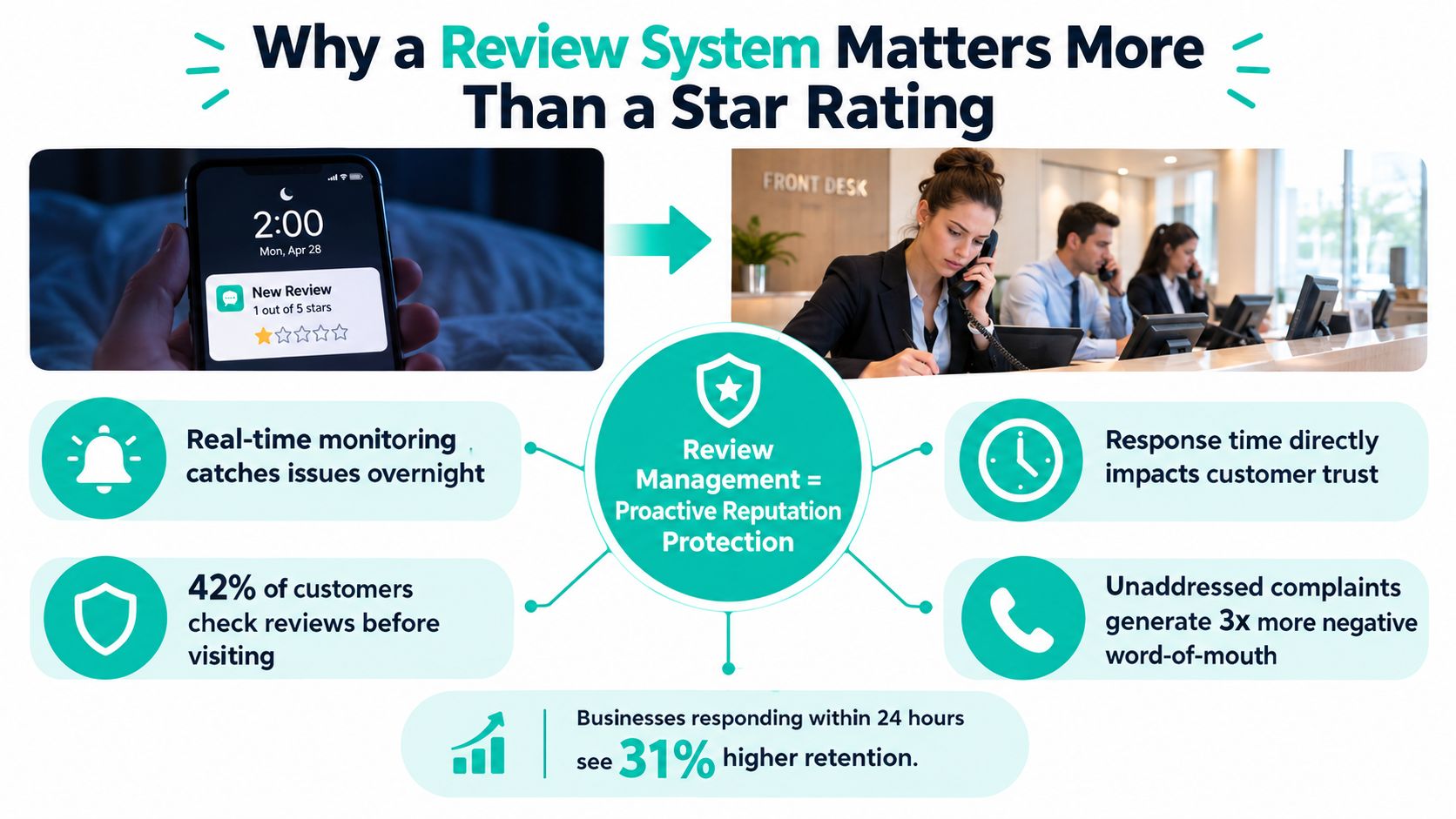
A one-star review lands at 2 a.m. The owner wakes up to a notification, sees the complaint spreading through the profile, and spends the morning helping the front desk answer questions that should have been handled through a clear process.
That's the reality of small business review management. It isn't a one-time cleanup project or a race to collect five-star ratings. It's a trust-governance system that controls how your business requests feedback, monitors public conversations, protects customer privacy, responds to complaints, and turns recurring issues into operational improvements.
Table of Contents
- Why a Review System Matters More Than a Star Rating
- Choosing the Platforms Worth Your Time
- Asking for Reviews Without Crossing the Line
- Writing Responses That Build Trust
- Triaging and Escalating Sensitive Reviews
- Measuring What Actually Matters
- Turning Reviews Into Reputation Marketing
Why a Review System Matters More Than a Star Rating
Reviews affect how people discover and evaluate local businesses. BrightLocal's 2025 Local Consumer Review Survey found that only 4% of consumers never read online business reviews, which means approximately 96% read them at least occasionally. The same survey found that 74% use two or more review platforms when researching a local business.
That makes a documented workflow more valuable than reactive damage control. Your process should define who owns each profile, when the team requests feedback, how quickly someone responds, which complaints require escalation, and how review themes reach the person responsible for fixing the underlying issue.
Practical rule: Manage the inputs, not just the average. Volume, recency, platform coverage, response coverage, and review detail all shape how prospective customers interpret your reputation.
A dental practice with a strong rating but a small review history can look less established than a competitor with a slightly lower rating and a much deeper, more current record of patient feedback. Consumers want evidence that the experience is consistent, not just a polished average. Google also remains the leading review source, with 81% of surveyed consumers using Google for review information in 2025 according to BrightLocal's survey.
Build the operating system first
Start with four controls:
- Profile ownership: Confirm who can access Google Business Profile, Yelp, industry directories, and social profiles.
- Review requests: Trigger neutral requests after a legitimate completed interaction.
- Response standards: Set a clear owner for daily monitoring and a consistent voice for public replies.
- Escalation rules: Define what requires a manager, compliance lead, or attorney before anyone responds.
The goal isn't to eliminate criticism. That's impossible, and trying to do it often creates compliance problems. The goal is to make sure every legitimate review receives the right treatment, every serious allegation reaches the right person, and every recurring complaint produces a useful operational response.
For more broader marketing and reputation guidance, explore the Leaping Lemur Media journal. A review system belongs there, alongside local SEO, content, conversion strategy, and customer experience work.
Choosing the Platforms Worth Your Time
Start with customer behavior, then choose platforms. BrightLocal reports that approximately 96% of consumers read local business reviews at least occasionally, 74% use two or more review platforms, and 81% use Google for review information in 2025. A Google-only strategy misses part of the research journey. A Yelp-only or Facebook-only strategy creates an even narrower view of your business.
Your first priority should usually be Google Business Profile because it connects reviews with local discovery, directions, hours, services, and contact information. That doesn't mean every business should spread its effort across every directory. A neglected profile with outdated hours and unanswered complaints can weaken trust.
Match platforms to the customer journey
A dentist, eye doctor, or medspa should evaluate Google alongside healthcare platforms such as Healthgrades and Zocdoc where those platforms are relevant to the market. A law firm should assess Avvo and other legal directories. A B2B services firm may need G2 or Capterra, while a hospitality business should consider TripAdvisor.
| Platform | Best For | Priority Tier | Owner Action |
|---|---|---|---|
| Google Business Profile | Local discovery and broad consumer research | Core | Claim, verify, update, and monitor consistently |
| Yelp | Local service and location-based research | Market-dependent | Claim the profile and review category accuracy |
| Healthgrades and Zocdoc | Healthcare discovery | Healthcare-specific | Confirm provider details, services, and privacy-safe access |
| Avvo | Legal services research | Legal-specific | Verify attorney information and practice details |
| G2 and Capterra | B2B software and services | B2B-specific | Maintain company information and assign a response owner |
| TripAdvisor | Hospitality and travel decisions | Hospitality-specific | Keep location, hours, and experience details current |
For each priority profile, use a claim-and-verify checklist:
- Business identity: Confirm name, address, and phone consistency.
- Category: Select the most accurate primary and secondary categories.
- Customer information: Check hours, holiday schedules, booking links, and service descriptions.
- Visual proof: Upload current, accurate photos that represent the actual location and experience.
- Access: Verify that a named employee or agency has authorized ownership.
If your team can't monitor a profile regularly, deprioritize it. A smaller set of accurate, actively managed profiles beats a directory graveyard filled with stale information.
Businesses with complex location structures can also study enterprise review response workflows for ideas about permissions, routing, and accountability. The same principles apply to a two-location dental group, even if the implementation is simpler.
Local practices should also connect profile management with their broader dental marketing strategy, rather than treating reviews as an isolated task.
Asking for Reviews Without Crossing the Line
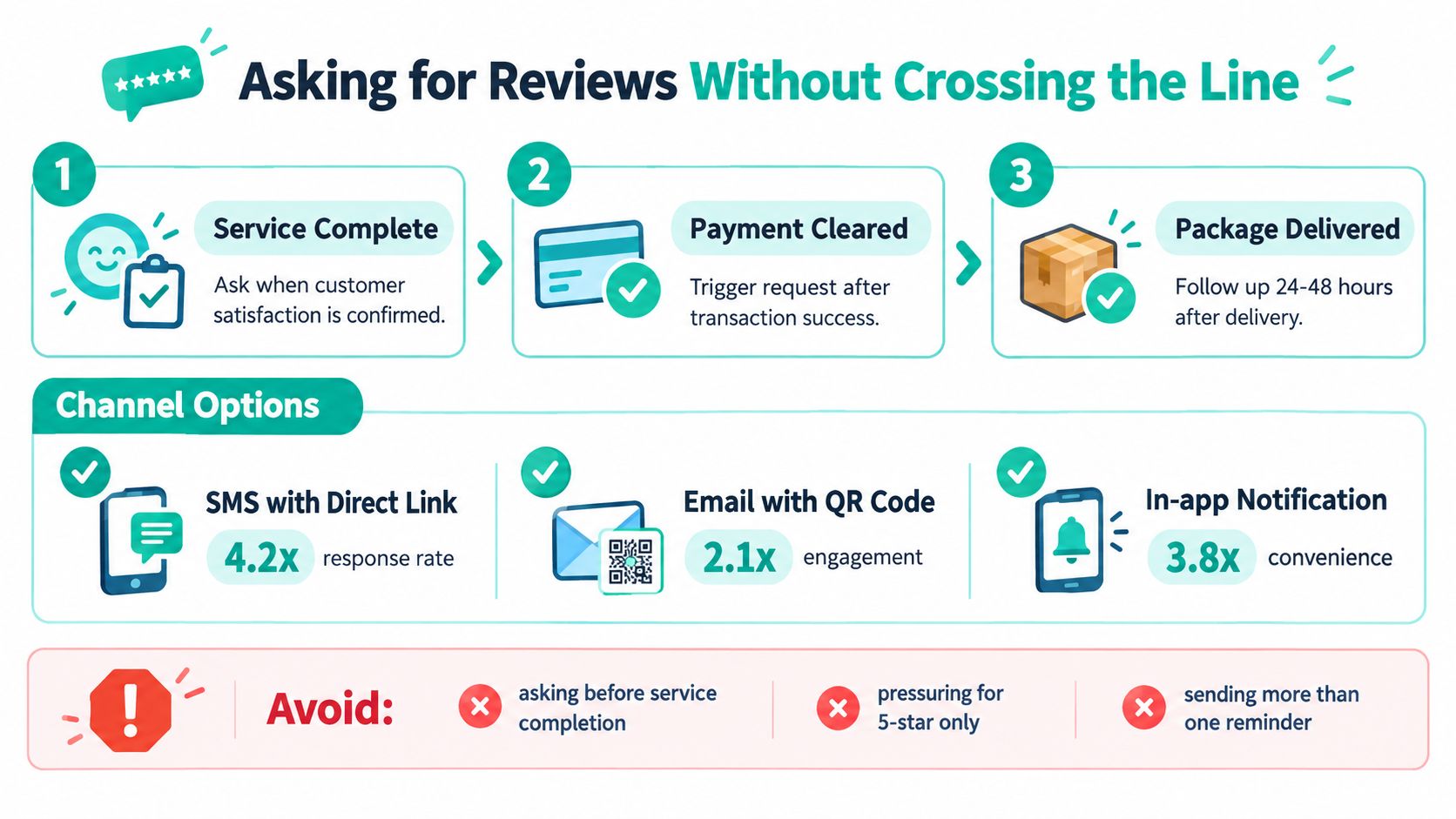
The ethical request is simple. Ask after a legitimate interaction is complete, use a low-friction channel, and invite honest feedback without steering the customer toward a favorable sentiment.
Good trigger points include a completed appointment, cleared payment, delivered package, finished project milestone, or closed service ticket. Use an SMS link, receipt QR code, or follow-up email that takes the customer directly to the relevant profile.
Email is the strongest reported solicitation channel in the available data. 40% of consumers said they were most likely to leave a review when asked by email, compared with 27% when asked in person, according to the 2025 survey summary from SEO FOMO.
Use neutral language
A request should never imply that only satisfied customers should respond. These templates are intentionally plain:
SMS
Thanks for choosing [Business Name]. We'd appreciate your honest feedback about your experience: [Review Link]
Subject: We'd value your feedback
Hi [First Name],
Thank you for working with [Business Name]. If you have a moment, please share your honest experience here: [Review Link]
Your feedback helps us understand what's working and where we can improve.
Thank you,
[Name]
In-person
We appreciate you coming in today. After your visit, we'll send a link where you can share honest feedback about your experience.
Know the compliance traps
The FTC's final rule on deceptive reviews and testimonials prohibits fake or false reviews, purchased reviews, insider testimonials without appropriate disclosure, review suppression, and incentives tied to a particular sentiment. The FTC announcement states that civil penalties can reach up to $51,744 per violation, subject to inflation adjustments.
The difference between these two offers is substantial:
| Solicitation | Compliance Risk |
|---|---|
| “Share an honest review and receive the same courtesy offered to every participant.” | Potentially acceptable only if the request doesn't require positive sentiment and complies with platform rules |
| “Leave a five-star review to receive a gift card.” | Prohibited incentive tied to sentiment, with serious legal and platform risk |
Never route unhappy customers to a private form while sending only happy customers to public review sites. That practice distorts feedback and can become review suppression. Ask everyone through the same neutral process, then use private service recovery as a separate operational channel.
Writing Responses That Build Trust
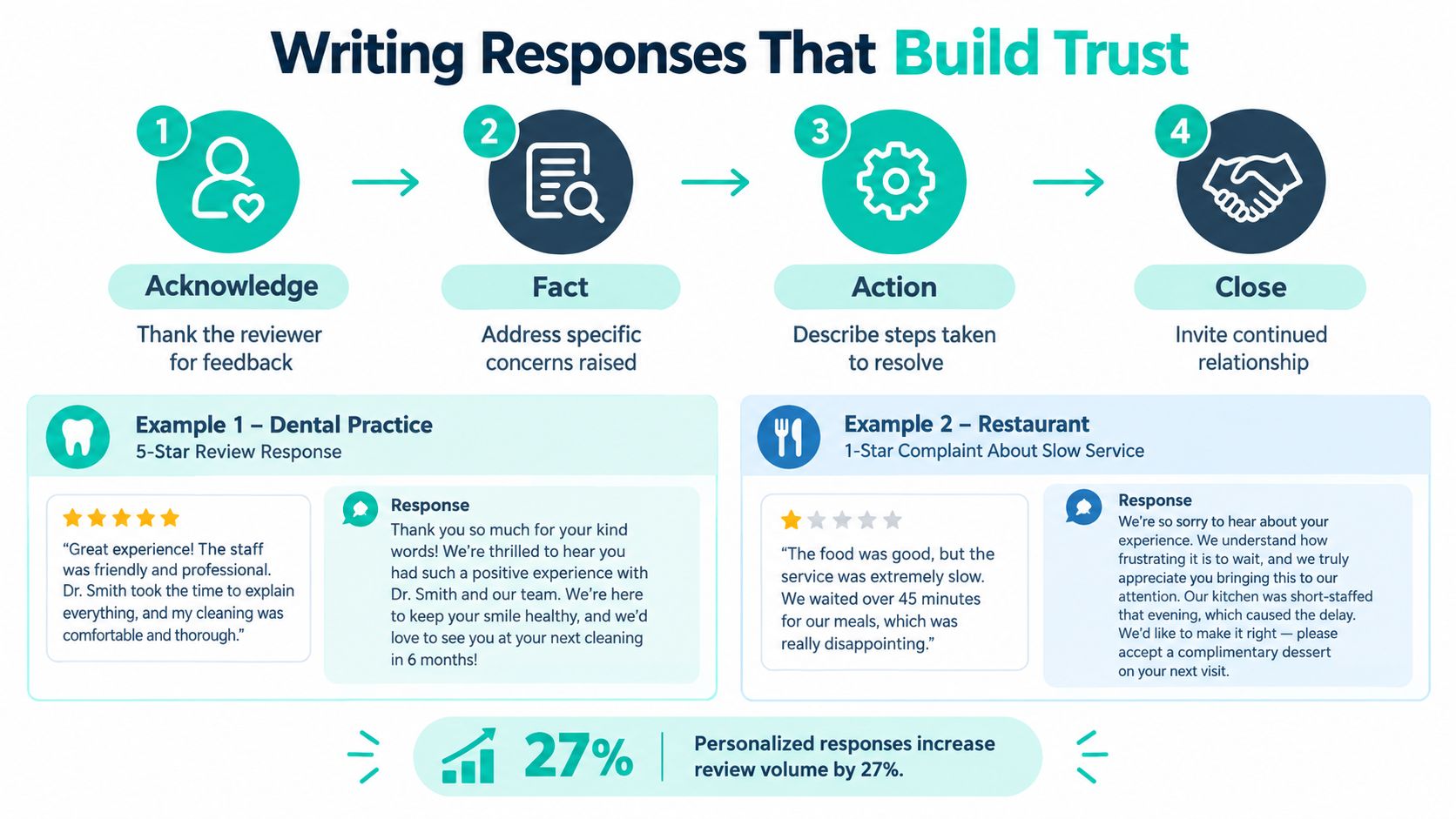
A useful public response follows four moves:
- Acknowledge: Thank the reviewer for taking time to respond.
- Fact: Refer to the specific point they raised without exposing private information.
- Action: Explain what you're doing next, when appropriate.
- Close: Invite continued contact through an official channel.
Example for a dental practice
A patient praises the dental team for explaining a treatment plan clearly.
Thank you for sharing this, [First Name]. We're glad our team took the time to explain your options and make the visit feel comfortable. We appreciate your trust and look forward to welcoming you back.
[Owner Name], [Practice Name]
The response is warm because it names the meaningful detail. “Thanks for the review” alone is too thin. Specificity shows prospective patients that the practice reads feedback.
Example for a medspa complaint
A reviewer says a scheduling error caused a frustrating delay.
Thank you for bringing this to our attention. We're sorry the scheduling process created frustration and didn't meet the standard we expect. Please contact [Official Contact] so our team can review the situation privately and work toward a resolution.
[Owner Name], [Medspa Name]
Don't argue about the timeline in public. Don't blame the reviewer. Don't promise a remedy the team hasn't approved.
Protect privacy in sensitive industries
Healthcare, legal, and financial businesses need stricter controls. Never confirm that someone is a patient or client. Don't mention an appointment, diagnosis, procedure, case detail, payment issue, or treatment outcome, even if the reviewer disclosed it first.
Use a safe template:
Thank you for sharing your concern. We take feedback seriously and would like to understand more. Please contact our official office channel so a member of our team can assist you privately.
Same-day responses are a strong operational standard, but speed doesn't excuse careless wording. Personalize the first sentence, address the actual concern, and use a sign-off that identifies the owner or responsible manager. Those habits make the profile feel managed by accountable people rather than an anonymous brand account.
Triaging and Escalating Sensitive Reviews
Every review shouldn't follow the same path. A compliment, a billing complaint, a safety allegation, and a suspected fake review demand different owners and different documentation.
| Bucket | Trigger Example | Owner | Response SLA | Public Reply? |
|---|---|---|---|---|
| Operational | Complaint about wait time, phone handling, or unclear instructions | Department manager | Promptly after review | Yes, concise and specific |
| Service Recovery | Customer describes a failed appointment, missed expectation, or unresolved issue | Customer experience lead | Promptly, with private follow-up | Yes, acknowledge and redirect |
| Sensitive | Safety, discrimination, harassment, fraud, or professional-conduct allegation | Authorized manager or compliance lead | Immediately | Holding response only after review |
| Spam or Defamation | Impersonation, irrelevant content, extortion, or suspected fabricated experience | Profile owner and platform contact | As soon as evidence is preserved | Only if a safe factual reply is approved |
Create an incident path
For a sensitive review, the first responder shouldn't improvise. Follow a documented sequence:
- Assign ownership: Name the manager or compliance role responsible for the case.
- Preserve evidence: Save a screenshot, timestamp, profile URL, review text, and internal ticket before requesting removal.
- Check the facts: Review internal records only through authorized personnel.
- Set the escalation threshold: Involve legal counsel when the review alleges injury, discrimination, fraud, extortion, professional misconduct, or a threat of formal action.
- Use a holding reply: Thank the reviewer for raising the concern, avoid admitting liability, and provide an official private contact route.
- Record the outcome: Note corrective action, follow-up responsibility, and whether the platform accepted or rejected a report.
A public response isn't the investigation. It's a controlled acknowledgment while the business determines what happened.
Google's review and fake engagement policy prohibits fake or incentivized reviews and allows profile-level restrictions when violations occur. It can temporarily prevent new reviews, unpublish existing ratings, or display a warning to consumers when fake activity has been removed.
Before requesting deletion, capture the exact content, account details that are publicly visible, the date, the suspected policy category, and any supporting records. Don't ask for removal just because a review is negative. Platforms require a policy violation, not disagreement with the customer's opinion.
Measuring What Actually Matters
A review dashboard should tell you whether the business is earning representative feedback, responding consistently, and learning from recurring complaints. Average rating matters, but it's only one part of the picture.
A high rating based on a thin review history may provide less confidence than a slightly lower rating supported by a larger, current, and detailed set of experiences. The operational benchmark should be response coverage, not just the number displayed beside the stars. BrightLocal found that 89% of consumers would use a business that responds to all reviews, compared with 44% who would use one that doesn't respond at all. That makes response behavior a visible trust signal.
Track five KPIs monthly
| KPI | Definition | Target Range | What It Signals |
|---|---|---|---|
| Review Volume | New legitimate reviews received during the period | Consistent and representative | Whether feedback collection is active |
| Average Rating | Mean rating across priority profiles | Stable or improving without suppression | Broad satisfaction, with limited context |
| Response Rate | Share of reviews receiving a business response | As close to complete as practical | Accountability and communication discipline |
| Response Time | Time between publication and first response | Fast enough for the issue's severity | Whether the workflow is staffed |
| Sentiment Mix | Distribution of praise, neutral feedback, and complaints | Balanced and interpreted by theme | Whether the business is hearing from varied customers |
Don't create a score that rewards the team for hiding difficult feedback. Instead, normalize each KPI against a benchmark you define for the business, assign each a score from 0 to 100, and calculate the average. Keep the formula visible in the dashboard so the owner can reproduce it without analyst support.
For example, the response-rate component should reflect coverage, while the sentiment component should reflect recurring themes rather than only counting favorable stars. A detailed complaint about billing may be more valuable operationally than several vague compliments.
Use a simple reporting rhythm
A five-minute weekly scan catches new issues before they become stale. A monthly review should examine platform coverage, response gaps, recurring categories, and corrective actions. A quarterly strategy review should decide whether the request timing, profile mix, service process, or escalation rules need adjustment.
The Harvard Business School summary of TripAdvisor hotel data reported 12% more reviews after hotels began responding and an average rating increase of 0.12 stars. That result shouldn't be treated as a guaranteed benchmark for a dental, legal, or medspa practice, but it supports a practical conclusion: responding is not decorative. It can contribute to a stronger feedback loop when the business also improves the experience behind the review.
Turning Reviews Into Reputation Marketing
A review that sits only on Google or Yelp does one job. With permission and careful privacy controls, the same customer feedback can support your website, social content, email, and in-person conversion points.
Start with the source platform's rules. Don't scrape or reproduce review content in ways the platform prohibits. Don't publish a reviewer's identity or customer context without appropriate permission. Healthcare practices must avoid revealing protected information, law firms must consider attorney advertising requirements, and financial businesses need to review applicable disclosure obligations before using testimonials.
Build five controlled reuse paths
Website proof should support a decision, not decorate the page. Use approved review content near the homepage contact action, location details, or service explanation. If you use a live Google feed or widget, verify that the implementation follows Google's current terms and accurately identifies the source.
A testimonial page can collect selected excerpts with the reviewer's permitted first name and date. Preserve the meaning of the original feedback, and don't edit a complaint into praise. For regulated services, obtain documented permission and remove details that could identify a patient, client, matter, or financial situation.
Social posts work best when they retain context. Recycle a relevant review into an Instagram or Facebook post only with appropriate attribution and permission, and add a short explanation of what the team did well. A screenshot of unexplained stars is weak content. A specific customer observation paired with a real operational detail is more credible.
Email can use approved excerpts in a welcome sequence or post-inquiry message. Keep the review relevant to the recipient's concern, avoid implying guaranteed outcomes, and link to a page where the business can be evaluated in broader context.
At the point of sale, a QR-linked card can make it easier for customers to find the review profile. The card should invite honest feedback, not request a particular rating or hide the route for dissatisfied customers.
A practical starter list
- Claim profiles: Confirm ownership, categories, hours, photos, and contact details.
- Review the website setup: Add only a compliant, clearly sourced display of approved feedback.
- Publish one testimonial page: Include permission records and privacy review.
- Draft two social posts: Use specific excerpts with proper attribution.
- Add one email block: Place relevant feedback in a welcome or follow-up sequence.
- Create a physical prompt: Use a neutral QR card at the appropriate customer touchpoint.
Review management becomes more valuable when it informs the rest of your marketing system. Businesses looking for help connecting reputation work with broader growth channels can review Leaping Lemur Media's services, including strategy and content support for practices and local businesses.
Leaping Lemur Media can help you build a review workflow with neutral post-treatment requests, privacy-safe response guidance, profile monitoring, and reporting that turns customer feedback into better marketing decisions. Visit Leaping Lemur Media to discuss a practical reputation system for your practice or small business.