
More patients won't automatically create a healthier optometry practice. The stronger growth opportunity is often a better mix of medical eye care, reliable operations, and genuine community trust. U.S. estimates project routine refractive-care demand to rise 3.2% from 2015 to 2025, while medical eye-care demand is projected to increase 31.5%, from 51.8 million to 68.2 million annual exams (Modern Optometry).
That gap changes the growth conversation. A practice that only promotes routine exams and eyewear may attract attention, yet miss the patients who need dry-eye treatment, myopia management, diabetic eye care, glaucoma evaluation, urgent visits, or coordinated medical care. Sustainable optometry practice growth comes from deciding what your practice should be known for, building the capacity to deliver it, and showing up in the community as a trusted healthcare partner.
Table of Contents
- Redefining Optometry Practice Growth for Today
- Understanding the Shifting Landscape of Eye Care
- Defining Your Practice Identity and Positioning
- Strategies for Patient Acquisition and Community Connection
- Building Retention and Referral Systems
- Measuring Success and Expanding Access
- Partnersing for Long-Term Flourishing
Redefining Optometry Practice Growth for Today
Growth used to be measured mainly through patient volume, optical sales, and monthly revenue. Those numbers still matter, but they don't tell you whether the practice is becoming more clinically valuable or just busier. A full schedule can conceal weak recall, poor follow-up, no-shows, underused providers, and a patient experience that doesn't generate loyalty.
The better question is: What kind of practice are you building, and whom does it serve best?
The U.S. Bureau of Labor Statistics projects optometrist employment to grow 10% from 2025 through 2035, substantially faster than the average for all occupations, with approximately 2,000 optometrist openings each year over the decade (U.S. Bureau of Labor Statistics). That projection supports a larger view of the profession. Demand is expanding, but so is the need for practices to communicate their clinical value clearly.
More demand requires sharper choices
Independent practices compete with corporate optical providers, medical systems, and nearby clinicians. A generic message such as “eye care for the whole family” rarely gives a patient a compelling reason to choose one practice over another. It also doesn't help staff decide which services to prioritize or which community relationships to develop.
Intentional growth starts with three decisions:
- Clinical focus: Choose the medical services that fit your training, equipment, staffing, and local patient needs.
- Community identity: Define the people, neighborhoods, employers, schools, and referral partners your practice wants to serve.
- Patient promise: Describe the experience patients can consistently expect, from the first call through follow-up.
A practice may position itself around accessible medical eye care for older adults, practical myopia management for families, or responsive care for patients with chronic conditions. The choice matters less than the alignment between the promise and the actual operation.
Practical rule: Don't advertise a service until your team can explain it, schedule it, document it, and follow up on it consistently.
Build relationships, not just reach
Transactional marketing asks people to book. Relational growth gives people a reason to trust the practice before they need an appointment. That means publishing useful education, participating in local conversations, partnering with complementary healthcare providers, and making the practice feel recognizable both online and in person.
The strongest practices don't treat community connection as a campaign that ends when the advertising budget does. They build a recognizable presence around the issues patients already care about, including clear vision, aging well, managing children's myopia, living with diabetes, and accessing affordable care.
Understanding the Shifting Landscape of Eye Care
The profession has a strong economic foundation, but that doesn't mean every practice will grow comfortably. The opportunity is expanding alongside competition, changing service needs, and workforce pressure. Owners who wait for demand to solve these problems will find that demand alone doesn't create capacity or differentiation.
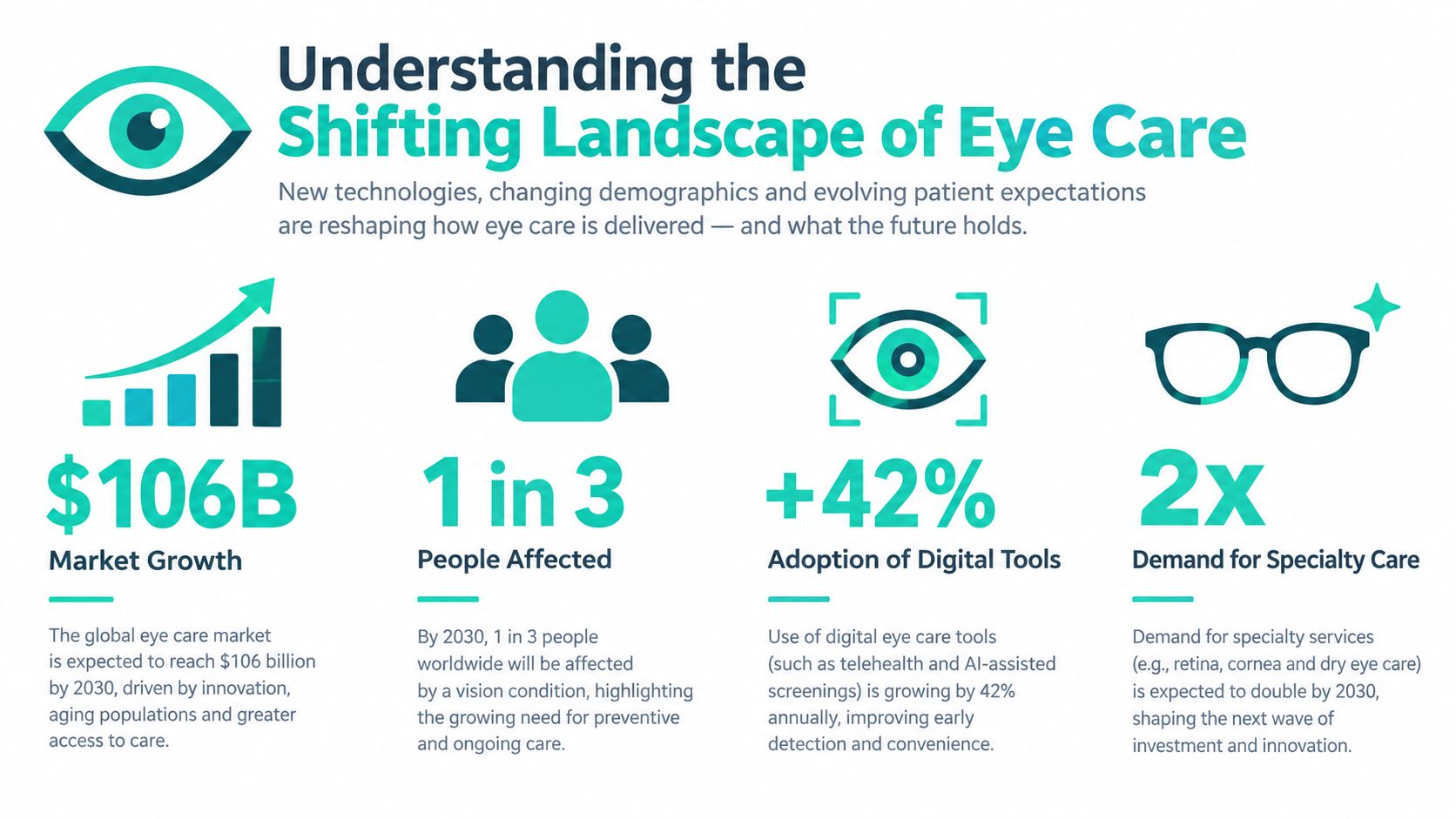
The most important shift is the service mix. Routine refractive care remains essential, but medical eye care is expanding faster according to the projections cited above. That creates an opening for practices that can offer more clinically meaningful care without abandoning the welcoming, personal experience that makes independent practices distinctive.
Demand is broad, but patient needs are specific
The global eye-care market was valued at approximately $22.0 billion in 2025 and is projected to reach $28.8 billion by 2033, representing a 3.4% compound annual growth rate from 2026 through 2033 (Grand View Research). Those figures describe a broad market, not a guaranteed outcome for an individual practice. They do show why owners should think beyond eyewear transactions and consider the full continuum of eye health.
That continuum can include:
- Routine examinations and refractive correction
- Contact-lens evaluation and ongoing care
- Dry-eye assessment and treatment
- Myopia management
- Diabetic eye disease monitoring
- Glaucoma risk evaluation
- Urgent visits and co-management
- Referral pathways for conditions outside the practice's scope
The right service mix depends on local need and internal readiness. Adding a specialty without adequate training, equipment, protocols, or follow-up creates frustration for patients and staff. A smaller, well-run clinical expansion is more valuable than a long menu of services that the practice can't deliver reliably.
Competition makes positioning operational
Corporate providers may compete on convenience, selection, or price. Hospital systems may compete on perceived medical authority. Independent practices can compete through a combination of clinical continuity, local trust, and a patient experience that feels personal rather than standardized.
That advantage only works when the practice can prove it. Your website should explain what your clinicians treat, who benefits from each service, what a visit involves, and how patients can take the next step. Your staff should use the same language in conversations. Your referral partners should understand exactly when and why to send someone to you.
A useful place to develop that public-facing message is the Leaping Lemur Media journal, where practice owners can think through brand, content, and community communication without separating marketing from patient experience.
Defining Your Practice Identity and Positioning
A practice can't communicate a meaningful identity if the owners haven't made the underlying choices. Branding isn't a logo exercise. It's the practical work of deciding what you do especially well, whom you want to help, and how patients should feel when they interact with your team.
Start with an internal conversation, not a marketing campaign.

Identify the practice you can honestly become
Write down the answers to four questions:
- Which clinical problems do we want to solve more often? Look at the services your clinicians enjoy, the equipment you already have, referral patterns, and recurring patient questions.
- Which patients benefit most from that expertise? A myopia-focused practice may speak differently to parents than a practice centered on aging eyes or chronic disease management.
- What makes our experience distinct? Consider communication, appointment access, continuity, education, family involvement, or the way staff support anxious patients.
- What would patients say about us after a good visit? Their language is often more useful than internal marketing phrases.
Avoid broad claims you can't defend. “Personalized care” means little unless you explain what personalization looks like. It might mean longer education during a medical visit, a consistent clinician, follow-up calls after treatment, or clear coordination with a primary-care provider.
Turn identity into a usable message
Your positioning should help a patient understand three things quickly: what you do, who you help, and why the experience is worth choosing. A clear statement might connect a clinical specialty with a local commitment, such as helping families manage myopia through practical education and ongoing monitoring.
Then express that position consistently across:
- The homepage and service pages
- Google Business Profile information
- Appointment confirmation and intake messages
- In-office signage and staff scripts
- Community presentations and partner materials
- Educational content and social posts
The global eye-care market's projected expansion, cited earlier, creates room for practices with different clinical identities. The mistake is trying to appeal to everyone with the same message. A practice becomes easier to find and remember when its expertise has a clear shape.
Patients don't need a louder practice. They need a clearer reason to trust yours.
Test your positioning with real patients, referral partners, and staff. Ask what they think you specialize in, which patients they believe you serve, and what words they would use to describe the experience. If their answers don't match your intended identity, revise the message or the operation.
Strategies for Patient Acquisition and Community Connection
Patient acquisition works best when it follows the practice's identity. If your message promotes medical eye care but your website makes booking difficult, the campaign exposes a weakness. If you want to serve patients facing affordability concerns but your pricing and payment information are difficult to find, your marketing creates uncertainty instead of trust.
Start with the path from discovery to appointment.
Make local discovery useful
Build service pages around actual patient needs, not a list of clinical terms. A page about dry eye should explain symptoms, evaluation, treatment options, and who should schedule. A page about diabetic eye care should explain why monitoring matters and what patients can expect. Each page should include a clear booking option and a phone number that works during the hours patients are likely to call.
Keep the practice's local presence accurate. Your address, hours, services, clinicians, and appointment instructions should match across your website and business listings. Ask satisfied patients for honest reviews, respond professionally to concerns, and use questions from calls and visits to guide future content.
The optometry marketing resources from Leaping Lemur Media can help practices connect local search, patient acquisition, and booking-focused communication.
Connect with people before they need care
Community connection shouldn't mean sponsoring every event available. Choose activities that match the patients and services you want to build.
A pediatric or myopia-focused practice might collaborate with schools, parent groups, or youth organizations on practical vision education. A practice serving older adults might work with senior communities, employers, primary-care offices, or organizations that support independent living. A practice focused on medical eye care can develop referral relationships with physicians and other healthcare providers.
Useful community activity includes:
- Educational sessions: Explain a specific concern in plain language and give attendees a clear next step.
- Referral partnerships: Tell local clinicians which symptoms, risks, or patient needs should prompt a referral.
- Access initiatives: Offer transparent pricing information, payment pathways, or partnerships that reduce practical barriers.
- Listening sessions: Ask community members what prevents them from seeking eye care, then adapt communication accordingly.
In 2024, an estimated 32.17 million Americans had presenting visual-acuity loss, including 25.02 million people with uncorrected refractive error that could potentially improve with appropriate corrective lenses (Centers for Disease Control and Prevention). That opportunity isn't an invitation to use fear-based messaging. It is a reason to explain the value of correction, prevention, and evaluation to people who may not recognize that care could help them.
Measure acquisition by source and quality. Track whether patients came through local search, a physician referral, a community event, a family recommendation, or an educational page. Then compare not only bookings, but completed visits, service needs, and ongoing engagement.
Building Retention and Referral Systems
Retention is a clinical and operational discipline. Patients return when the practice remembers what matters, makes follow-up easy, and delivers care that feels connected rather than episodic. A referral happens for the same reason. Patients recommend practices they trust to treat someone they care about.
Start by fixing the leaks that staff can see every week.
Protect the appointment book
A randomized outpatient trial involving 9,835 analyzed patients recorded no-show rates of 23.1% without reminders, 17.3% with automated reminders, and 13.6% when front-desk staff called three days before the appointment (Eye Care Works). Those figures come from a specific outpatient setting, so they shouldn't be copied as a guaranteed result for community optometry. They do support testing reminder timing and escalation rather than assuming one message works for everyone.
Create a weekly dashboard with:
- Appointment utilization
- No-show rate
- New-patient share
- Revenue per completed exam
Segment the results by provider, appointment type, booking channel, patient status, and lead time. A reminder isn't successful because it was sent. It succeeds when the patient attends or cancels early enough for staff to offer the time to someone else.
Turn recall into a relationship
A recall system should feel personal, not like a broadcast. Use the patient's preferred channel, reference the reason for follow-up when appropriate, and make scheduling simple. When a patient doesn't respond, record the attempt and continue according to a defined sequence rather than relying on memory.
The same principle applies outside healthcare. The resource on how cafés can keep customers returning offers useful retention thinking for any service business, especially the importance of making repeat engagement convenient and recognizable.
| Retention and Recall Benchmarks | Impact |
|---|---|
| Automated appointment reminders | Give patients a consistent prompt and create an opportunity to confirm or cancel |
| Staff calls for higher-risk appointments | Add a human touch where a missed visit would create a larger clinical or operational problem |
| Segmented recall lists | Help staff prioritize overdue patients by clinical relevance, attendance history, and contact quality |
| Recorded outcomes | Show whether outreach produced contact, booking, attendance, and completed care |
Referral requests should follow a positive care moment, not arrive as a desperate plea. Give patients a simple way to recommend the practice, explain which services you provide, and thank them without creating pressure. The best referral program is supported by dependable care, clear communication, and a team that treats every patient as part of the practice's reputation.
Measuring Success and Expanding Access
Revenue is a lagging indicator. By the time it falls, the underlying problems may have been present for weeks or months. Owners need a capacity-and-access dashboard that shows whether the practice is converting demand into completed care.
Review four measures every week: appointment utilization, no-show rate, new-patient share, and revenue per completed exam. Add operational context, including available appointment capacity, cancellation timing, provider schedules, and booking source. This prevents the team from celebrating gross bookings that never become attended visits.
Measure the recall funnel honestly
A study of 16 ophthalmic practices found that conversion from a single recall round was typically 25% to 40%, while 67% of practices reported making only one recall attempt (MillennialEYE). The practical lesson is clear. A single unanswered message doesn't prove that a patient is lost, and a booked appointment doesn't prove that recall worked.
Track each cohort through:
- Valid contact
- Response
- Booking
- Attendance
- Completed service
- Revenue after communication costs
Remove inactive, deceased, transferred, and clinically inappropriate records before judging performance. Separate patients with long gaps or invalid contact information from patients who recently became overdue. The resulting data will tell you whether the problem is contact quality, message relevance, scheduling friction, or attendance.
For practices expanding medical services, revenue-cycle discipline also matters. A practical vision medical billing revenue guide can help owners think through the connection between clinical documentation, coding, claims, and collected revenue.
Treat access as a growth strategy
Healthwatch England found that the leading reasons people hadn't attended eye care in the prior two years were not feeling they needed an appointment, at 25%, and affordability, at 23%. Patients encouraged to purchase additional paid services were twice as likely to report avoiding eye care (Healthwatch England).
That finding should change the tone of growth. Explain value without turning every visit into an upsell. Publish transparent pricing information, clarify what insurance does and doesn't cover, offer payment pathways where feasible, and show how preventive care supports daily function.
Track first-time patients, abandoned bookings, self-reported affordability barriers, referral sources, and conversion by community segment. A practice that removes access friction can grow while serving people who have been overlooked by conventional acquisition campaigns.
Partnersing for Long-Term Flourishing
Flourishing practices don't treat marketing as a vendor task or growth as a short campaign. They align clinical services, staff behavior, community relationships, and public messaging around a clear identity.
That requires a team willing to listen, test, measure, and adjust. It also requires partners who understand that a practice's reputation is built through hundreds of ordinary interactions, not just polished advertisements. Leaping Lemur Media's services reflect that broader approach, connecting positioning, content, local visibility, and intentional execution.
Choose growth that makes the practice more useful to its community. When clinical expansion improves access and the brand communicates with honesty, optometry practice growth becomes more than a fuller schedule. It becomes a practice patients understand, trust, and recommend.
Leaping Lemur Media helps optometry practices clarify their positioning, strengthen local search visibility, and connect patient acquisition with real booking behavior. Visit Leaping Lemur Media to start a conversation about building a practice that grows with intention and flourishes in its community.