You're booked solid, answering messages between appointments, and still wondering why the bank balance doesn't reflect how hard everyone is working. Meanwhile, marketers keep offering disconnected fixes: more social posts, a new website, paid ads, or an AI tool that promises to solve the pipeline.
A small business growth consultant should not add another tactic to that pile. The right advisor finds where revenue, capacity, trust, and follow-up are breaking down, then builds an operating system that makes growth more durable. For dentists, eye doctors, medspa owners, law firms, and other owner-led practices, that means measuring the whole journey, protecting professional judgment, and choosing fewer initiatives that the team can execute.
Table of Contents
- What a Small Business Growth Consultant Actually Does
- Why Small Business Growth Is Harder Than It Looks
- Services and Deliverables You Should Expect
- Pricing Models, Fees, and How to Estimate ROI
- Measuring What Actually Matters Beyond Leads
- The Responsible Way to Use AI as a Growth Lever
- What Good Looks Like Across Three Practice Types
- Hiring Checklist and Your First 30 Days With a Partner
What a Small Business Growth Consultant Actually Does
A practice owner usually doesn't need another vendor who delivers activity without accountability. You need someone who can look at your positioning, customer journey, operations, finances, and reporting together, then explain which constraint deserves attention first.
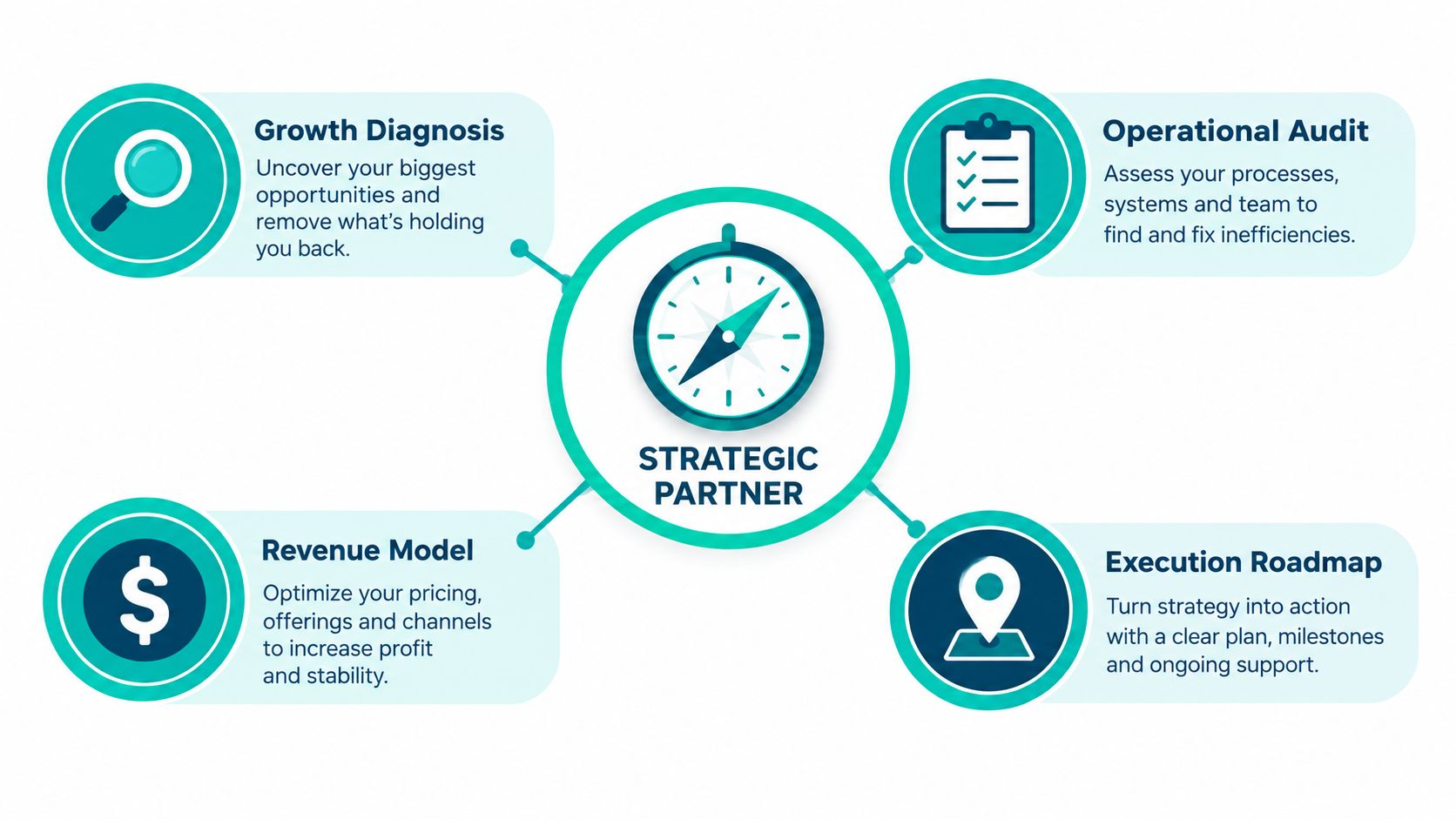
In plain English, a small business growth consultant diagnoses where the business is leaking opportunity, sets a clear direction, sequences the work, and ties each initiative to a measurable commercial outcome. That could mean improving inquiry handling before increasing traffic, clarifying a service offer before launching a campaign, or fixing follow-up before buying another lead source.
The role sits between several familiar categories:
- A marketing agency usually owns specific promotional execution, such as SEO, paid media, content, or web development.
- A business coach often focuses on the owner's decisions, habits, leadership, and accountability.
- A fractional CMO typically leads the marketing function and manages channel strategy, team coordination, and reporting.
- A growth consultant connects strategy, marketing, operations, and measurement so the business can grow without outrunning its capacity.
That distinction matters. A consultant shouldn't recommend a campaign just because it's popular. They should first ask whether your staff can respond quickly, whether your booking process works, whether the service is profitable, and whether the practice can deliver the promised experience consistently.
The six questions your consultant should answer
By the end of a serious engagement, you should know:
- Who are we best positioned to serve?
- Why should the right people choose us?
- Where are prospects dropping out of the journey?
- Which growth constraint should we fix first?
- What numbers will tell us whether the work is paying off?
- What can the team sustain without damaging service quality or cash flow?
If a proposal can't help answer those questions, it's probably selling an activity rather than solving a business problem. Review the provider's perspective and capabilities on the Leaping Lemur Media about page and look for evidence that the relationship is built around diagnosis and partnership, not just deliverables.
Why Small Business Growth Is Harder Than It Looks
Small businesses carry enormous economic weight, but that doesn't make individual growth easy. OECD data show that SMEs represent 99% of all businesses across the OECD area, employ roughly two out of every three workers, and generate between 50% and 60% of value added. The OECD SME indicators overview also notes that smaller firms can respond quickly because they have shorter decision-making lines and closer relationships with users.
That flexibility is useful, but it comes with exposure. An owner-led practice can change its offer quickly, yet it may not have dedicated marketing, finance, analytics, or operations teams. The owner often makes the strategic decision, answers the phone, approves the campaign, manages the staff, and absorbs the consequences when a new initiative fails.
Practical rule: Growth advice must protect the business's ability to keep operating, not just increase attention.
The survival data makes that point hard to ignore. The U.S. Small Business Administration reports that, among new employer establishments from 1994 through 2022, an average of 67.7% survived at least two years, 49.2% survived five years, 33.9% survived ten years, and 25.5% survived fifteen years. Those figures are documented in the SBA Office of Advocacy small-business FAQ.
Owner-led practices aren't venture-backed startups
A dental office, medspa, or law firm usually has different obligations from a venture-backed software company. The owner may value predictable income, clinical or professional quality, team stability, and community reputation more than rapid expansion. A plan that requires constant experimentation, aggressive discounting, or heavy hiring may conflict with those priorities.
That's why a consultant's first job is honesty about readiness. Before recommending more lead generation, they should examine appointment capacity, response time, cancellation handling, margins, staffing, retention, and the owner's actual appetite for change. Marketing can amplify a strong system, but it can't repair a service model that loses money or overwhelms the team.
Services and Deliverables You Should Expect
A mature consulting engagement produces working tools, decisions, and ownership. It doesn't stop at a slide deck filled with broad recommendations.
Strategy
The strategy layer should define your positioning, priority audience, commercial goals, and sequence of work. For an owner-led practice, a useful deliverable might combine a positioning statement with a 90-day growth plan tied to available capacity, cash flow, and service priorities. It should make clear what the team will not pursue yet.
Marketing
Marketing should produce more than a content calendar. Expect a channel mix, messaging hierarchy, audience assumptions, conversion paths, and a content system that the team can maintain. If you're comparing specialist providers, a resource on best lead gen marketing firms can help you understand how lead-generation capabilities differ, but lead volume still needs to fit your broader operating model.
Operations
Operations work turns strategy into a reliable patient or client experience. For a practice, that may include intake forms, call handling, appointment booking, reminders, consultation preparation, follow-up, and handoffs between staff. The consultant should identify who owns each step and what happens when a prospect doesn't respond.
Measurement
Measurement should connect activity to business outcomes. A practical scorecard separates leading indicators, such as response time and consultation bookings, from lagging indicators, such as accepted treatment, retained clients, gross margin, and referrals.
| Service Pillar | Core Deliverable | Typical Owner | Time Horizon |
|---|---|---|---|
| Strategy | Positioning and sequenced growth plan | Owner and consultant | Annual direction, reviewed quarterly |
| Marketing | Channel mix, messaging, and content system | Marketing lead or agency | Monthly execution |
| Operations | Intake, scheduling, and follow-up workflows | Practice manager | Immediate implementation, ongoing refinement |
| Measurement | Scorecard with leading and lagging indicators | Owner, consultant, or finance lead | Weekly review, monthly decisions |
The Leaping Lemur Media services overview provides an example of how brand, marketing, and growth support can be organized. Use any provider's service page as a starting point, then ask what you'll receive, who will use it, and how it changes a decision.
A proposal should also specify what remains with you. Consultants can design a workflow, but your team must follow it. Agencies can create campaigns, but someone must approve claims and respond to inquiries. Clear ownership prevents the common failure where everyone assumes someone else is responsible.
Pricing Models, Fees, and How to Estimate ROI
Consulting fees make more sense when you separate the payment structure from the value question. The right model depends on how clearly you understand the problem, how much implementation support you need, and whether results can be attributed fairly.
Monthly retainers suit practices that need ongoing prioritization, reporting, and coordination. They create continuity, but they can become wasteful if the scope isn't tied to decisions and outcomes.
Project-based fees work well for a defined diagnostic, positioning exercise, website plan, or operational redesign. They offer a clear endpoint, although the owner must budget for implementation after delivery.
Performance-linked arrangements appear attractive because payment depends on results. They're difficult to structure fairly when referrals, reputation, seasonality, staff performance, and offline relationships influence revenue. If you consider one, define the baseline, attribution rules, exclusions, reporting access, and payment timing in writing.
Don't accept invented benchmarks for what a consultant “should” generate. Use your own books:
- Record current monthly revenue and gross margin.
- Set a realistic target for incremental revenue.
- Calculate the maximum acquisition cost the business can tolerate.
- Estimate the consultant's contribution separately from ad spend, software, staff time, and implementation.
- Compare expected incremental gross profit with the full cost of the engagement.
A simple calculation is:
Estimated ROI = (incremental gross profit minus total engagement cost) ÷ total engagement cost
Use gross profit rather than revenue when possible. Revenue that requires excessive discounting, overtime, or unprofitable service delivery can make a campaign look successful while weakening the practice.
The broader economic case for small-business growth is substantial. From January 1995 through June 2023, U.S. small businesses created 20.2 million net new jobs, compared with 12.8 million from large businesses, accounting for 61.1% of net new job creation, according to the SBA FAQ on small business. That doesn't justify every consulting expense. It does justify treating sound growth systems as a serious business investment.
For software-related costs, review LunaBloom AI pricing plans alongside other tools, but include implementation time, training, review, and workflow changes in your calculation. A low subscription price can still produce a costly project if nobody uses the system correctly.
Measuring What Actually Matters Beyond Leads
More leads can hide a worsening business. A practice may receive a flood of low-fit inquiries while staff spend less time with qualified prospects, response times stretch, consultations go unbooked, and the owner blames marketing for an operational problem.
Local discovery matters. A 2025 industry compilation reports that 46% of Google searches have local intent and 86% of users rely on Google Maps to find a business, while also warning that visibility doesn't prove fit, trust, or revenue. See the local search statistics compilation for the cited figures.

Build a full-funnel scorecard
Track the journey in order, not just the first visible event:
- Source of inquiry: Record search, referral, community event, branded search, social, or another source.
- Service requested: Separate high-fit services from inquiries the practice can't serve profitably.
- Response time: Measure how quickly someone receives a useful human response.
- Consultation booked: Distinguish interest from a scheduled commitment.
- Show rate: Track whether booked people attend.
- Accepted treatment or matter: Measure the commercial decision that follows the consultation.
- Gross margin: Confirm that the work produces enough value after direct costs.
- Repeat visit: Identify whether the relationship continues.
- Referral: Capture whether satisfied patients or clients introduce someone else.
Each layer answers a different question. Traffic tells you that people arrived. A booked consultation tells you that the message and process created enough trust to secure time. An accepted treatment, retained matter, repeat visit, or referral tells you much more about fit and durable value.
Don't fake precision
Offline influence is real and often undercounted. A person may see a community sponsorship, hear a recommendation, search the practice by name, and then submit a form. A dashboard may credit branded search while missing the relationship that created the decision.
Ask every new inquiry how they heard about you, record the answer consistently, and review patterns with staff. Keep channel reporting, but don't pretend that every relationship belongs to one source. For ethical healthcare and legal marketing, fewer, better-fit inquiries and stronger retention can be healthier than maximum volume.
The Responsible Way to Use AI as a Growth Lever
AI adoption isn't a growth metric. A tool earns its place only when it improves a defined workflow without weakening confidentiality, accuracy, judgment, or trust.
The available adoption figures show why broad claims are unreliable. Verizon reports that 38% of small businesses use AI and 28% use it for marketing or social media, while another 2025 survey of 1,500 owners found adoption had fallen to 28%, with only 19% saying they might add AI, as summarized in the Verizon small-business survey coverage. The contradiction reflects different samples, definitions, awareness levels, and implementation quality. It doesn't prove that AI is either essential or irrelevant.
Start with low-risk workflows
Reasonable pilot uses include drafting internal content, summarizing campaign data, organizing questions for a staff meeting, or creating a first draft of a service description for expert review. The reviewer must verify every factual, clinical, legal, and brand-sensitive statement before publication.
High-risk uses need a much higher bar:
- Automated claims about outcomes or guarantees
- Unsupervised patient or client communication
- Prompts containing confidential records or sensitive personal information
- Advice that appears clinical, legal, or financial without qualified review
- Content that imitates the owner's voice without approval
Choose one workflow, establish a baseline, assign a human reviewer, and define stop/go criteria before deployment. Stop if accuracy declines, review takes longer than the original task, staff bypass the process, or the output creates complaints or compliance concerns. Continue only when the workflow produces a useful, repeatable improvement that you can observe in your own operation.
For a practical risk review, the guidance on how to avoid AI project failure can supplement your internal planning. Don't let a generic automation promise decide what belongs in a dental, medspa, or legal workflow. Your brand voice and professional responsibility matter more than content volume.
What Good Looks Like Across Three Practice Types
Consider three representative scenarios. The same consulting discipline produces different moves because each practice has a different customer journey, capacity model, and risk profile.
A multi-location dental group may discover that marketing is working, but phone handling and treatment follow-up are inconsistent. The consultant standardizes inquiry routing, clarifies the service pages for high-priority treatments, and creates a review process for missed consultations. The key measure isn't raw lead volume. It's the movement from qualified inquiry to attended consultation and accepted treatment. The group deliberately avoids discount-heavy campaigns that fill schedules with low-fit requests.
A boutique medspa may have strong visual content but weak differentiation. The consultant maps the audience, separates introductory services from higher-value treatment plans, and fixes the booking experience so prospects know what happens next. The practice tracks booked consultations, attendance, treatment acceptance, repeat visits, and referrals. It doesn't publish dramatic before-and-after claims unless the evidence, consent, and disclosure support the message. For category-specific planning, medspa marketing guidance can provide a relevant reference point, but the owner still needs a scorecard built for the practice.
A mid-sized law firm may receive regular inquiries but lose matters during intake. The consultant reviews practice-area positioning, response ownership, conflict-check handoffs, and follow-up. The firm measures qualified matters, consultation attendance, engagement decisions, and referral sources rather than celebrating every form submission. It deliberately avoids promises about likely outcomes and keeps messaging aligned with professional obligations.
The compliance principle is straightforward. The FTC states that advertising claims must be truthful, non-deceptive, and supported by evidence, and that endorsements must reflect the endorser's honest experience or opinion, as explained in its small-business advertising guidance. Testimonials shouldn't imply that an unusual result is typical without explaining what people generally can expect. Material relationships behind endorsements also need clear disclosure, according to the FTC's endorsement and review guidance.
The pattern is consistent: diagnose the constraint, make a small number of operational changes, measure the business outcome, and refuse tactics that create compliance or capacity problems.
Hiring Checklist and Your First 30 Days With a Partner
Look for relevant referrals, documented case outcomes, transparent pricing, a defined scorecard, and clear ownership boundaries. Ask: What would you diagnose first? Which metric would you ignore? What must we fix before buying traffic? Who implements the plan? How do you handle weak results? What information do you need? What does success look like? What won't you recommend? What happens after the first month? What would make you stop the engagement?
Use the first month to test fit: discovery week, diagnostic week, planning week, and kickoff week. A listener-first partner such as Leaping Lemur Media can help practices align positioning, audience insight, website conversion, and execution around growth they can sustain.
Leaping Lemur Media offers brand strategy, audience insight, conversion-focused website work, and marketing support for practices that want durable systems instead of disconnected tactics. Visit Leaping Lemur Media to explore a partnership built around your voice, your community, and the business outcomes that matter.