
Polished design alone doesn't persuade visitors. A beautiful website can still lose patients, clients, and enquiries when the copy avoids the questions people have. Effective website content addresses a specific concern, proves why the business is credible, and makes the next step obvious.
That matters because website content is now a serious acquisition channel, not filler around a layout. A 2026 marketing summary reports that 82% of marketers actively invest in content marketing, while 73% of B2B marketers and 70% of B2C marketers use it. It also reports that 91% of companies use video content, and 61% identify updating existing content as their most effective tactic. The lesson is practical: publish fewer generic pages and build more useful ones.
The following website content examples focus on the decisions that move visitors from trust to action. Each format includes adaptable copy for dentists, eye doctors, medspas, law firms, and small businesses, along with CTA guidance, compliance cautions, and a realistic way to make the content sound local and human. The best StoryBrand website designs for SMBs don't just look organized. They clarify who the business serves and why a visitor should take the next step.
Table of Contents
- 1. About Us Pages That Build Trust and Authority
- 2. Service and Treatment Pages Optimized for Patient Education and Conversion
- 3. Patient Testimonials and Review Showcase Content
- 4. Blog Content That Establishes Expertise and Drives Organic Traffic
- 5. Case Study and Success Story Content
- 6. FAQ Pages Optimized for Search Intent and User Experience
- 7. Video Content for Procedure Explainers and Introductions
- 8. Contact and Consultation Request Pages with Clear CTAs
- 9. Pricing and Investment Transparency Pages
- 10. Community and Social Proof Content for Local Connection
- Comparison of 10 Website Content Examples
- Turn These Examples Into a Website Content System
1. About Us Pages That Build Trust and Authority
An About Us page shouldn't read like a résumé pasted onto a website. It should answer the visitor's quiet concern, “Why should I trust you with this decision?” A dental practice might replace “Our team has extensive experience” with: “We opened our practice to make restorative care feel less rushed and more understandable for families in [location]. Every treatment plan starts with a conversation about comfort, priorities, and what you want your health to look like.”
That before-and-after shift moves from a vague claim to a clear point of view. Progressive dental practices can explain their patient-first philosophy, boutique eye-care clinics can show specialized expertise and community partnerships, and medspa owners can share the personal wellness or aesthetic journey that shaped their approach.

Show the people behind the credentials
Use first-person language where it sounds natural, introduce actual team members, and include high-quality photographs of the people visitors will meet. A law firm can explain why its attorneys chose a specific practice area. An optometry clinic can describe how it supports local schools or community health events. A small business can explain the customer problem that led to its founding.
A useful structure is:
- Origin: Explain why the practice or business began.
- Approach: Describe what the team does differently.
- Community: Show how the business contributes locally.
- Next step: Invite the visitor to meet the team or request a consultation.
Avoid unsupported superlatives, stock photos, and medical promises. Keep credentials accurate, identify professional roles clearly, and never imply that a personal story guarantees a particular patient outcome. A well-organized practice About page can provide the foundation, but the copy should still sound like the people who own and operate the business.
2. Service and Treatment Pages Optimized for Patient Education and Conversion
A service page should answer the reader's practical questions before asking for a booking. Lead with the problem the service addresses, explain what the appointment involves, then make the next action easy.
Compare:
“ We provide advanced dental implants.”
with:
“An implant replaces the visible tooth and the root support beneath it. During your consultation, we'll assess your oral health, explain suitable options, and discuss what recovery may involve.”
The second version gives patients a clearer starting point without promising a result.
Build the page around the visitor's decision
Use a simple sequence:
Understand: Define the treatment or service in plain language.
Assess: Describe situations in which someone may consider it, without diagnosing the reader.
Prepare: Explain consultation, preparation, treatment, and recovery.
Plan: State why a custom quote may be needed and what can affect the investment.
Act: Choose one primary CTA, such as “Request an implant consultation.”
A dental practice can adapt this format for implants, veneers, or orthodontics. An eye-care center can use it for LASIK, cataract surgery, or contact lens fitting. A medspa might explain Botox, fillers, or laser treatments by covering goals, appointment steps, expected downtime, and questions to ask. A law firm can describe a practice area, the matters it handles, and what information a prospective client should bring. Small businesses can use the same structure for consultations, repairs, or ongoing services.
Add a diagram, facility photograph, or procedure video only when it clarifies a decision. Avoid guarantees, fear-based copy, and before-and-after images unless consent and required context are in place. Keep clinical, legal, and financial claims accurate, and direct readers to professional advice where appropriate.
A dedicated service page collection can connect related FAQs, financing information, and the consultation page. Use a short CTA near the decision point, then repeat it at the end with a lower-pressure option, such as “Ask a question about your options.”
3. Patient Testimonials and Review Showcase Content
A five-star rating confirms satisfaction. It rarely explains why someone trusted the practice, what nearly stopped them, or which part of the experience changed their mind. Use testimonials to answer those questions with a specific, believable story.
Before: “Great service.”
After: “I had postponed replacing a missing tooth because I worried about discomfort. The team explained each stage, answered my questions without rushing, and helped me understand my options.”
The second version gives prospective patients language they can recognize. A dental practice can request stories about implants, veneers, or orthodontics. An ophthalmology center might feature concerns before vision correction. A medspa can highlight a client seeking a subtle result and respectful consultation. A law firm can focus on communication during a difficult matter, provided publication follows applicable professional rules.
Turn a review into a decision aid
Use a short prompt that produces useful detail, then keep the client's natural voice:
Starting concern: “What were you hoping to solve?”
Decision factor: “Why did you choose this practice or firm?”
Experience: “What helped you feel comfortable?”
Useful detail: “What would you tell someone considering the same service?”
A small business can adapt the same prompts for repairs, consultations, or ongoing services. Place the strongest sentence beside a relevant service, then add a low-pressure CTA such as “Ask a question about your options.” A booking button works when the testimonial resolves a clear concern. “Request a consultation” is better when the reader still needs guidance.
Get permission before publishing a name, image, video, treatment detail, or outcome. Healthcare practices must protect privacy and follow applicable advertising and patient-confidentiality requirements. Law firms should review rules covering testimonials, outcomes, disclaimers, and past matters. Keep claims accurate, avoid editing words into polished advertising copy, show a range of experiences, and answer negative reviews professionally with an invitation to resolve the issue privately.
Video can preserve tone and hesitation that text loses. For a practical format, see converting with video testimonials.
4. Blog Content That Establishes Expertise and Drives Organic Traffic
A practice blog should earn a booking before it earns traffic. The strongest posts answer a real pre-appointment question, clarify the decision, and make the next step obvious.
Start with a question patients or clients ask. A dentist might address bleeding gums or compare tooth-replacement options. An eye doctor could explain presbyopia, astigmatism, lens choices, and questions to bring to an eye exam. A law firm can explain a legal process in plain English while avoiding personal legal advice. Medspas can clarify treatment suitability, preparation, and realistic expectations. A small business can answer questions about repairs, consultations, or ongoing service.
Before: “Learn about our cosmetic services.”
After: “Which treatment suits uneven skin tone, and what should you ask before booking?”
That change gives the reader a useful answer instead of a keyword-filled page. Build each article around four decisions:
- Education: Define the problem or terminology.
- Options: Compare relevant treatments, services, or next steps.
- Evidence: Show the provider's experience and cite trustworthy references.
- Action: Link to the matching service page, consultation form, or booking option.
A practical article can use the snippet, “Recurring eye strain is not always a sign that you need new glasses. A complete eye exam can help identify the cause.” Follow it with a CTA matched to intent: “Book an eye exam” for a ready visitor, or “Ask what your options are” for someone still researching.
Google's helpful content guidance asks whether content serves people, demonstrates first-hand expertise, has a clear purpose, and is written or reviewed by someone who knows the subject. Those checks matter for health and legal topics. Review claims, qualifications, regulations, and recommendations before publication, and avoid promises about outcomes.
Consistency matters more than a rigid publishing schedule. Refresh articles when services, procedures, regulations, or recommendations change. Repurpose a useful post into an email, social caption, short video script, or patient handout. A practice journal, such as this content hub, works best when every article answers a real question and links to a relevant next step.
5. Case Study and Success Story Content
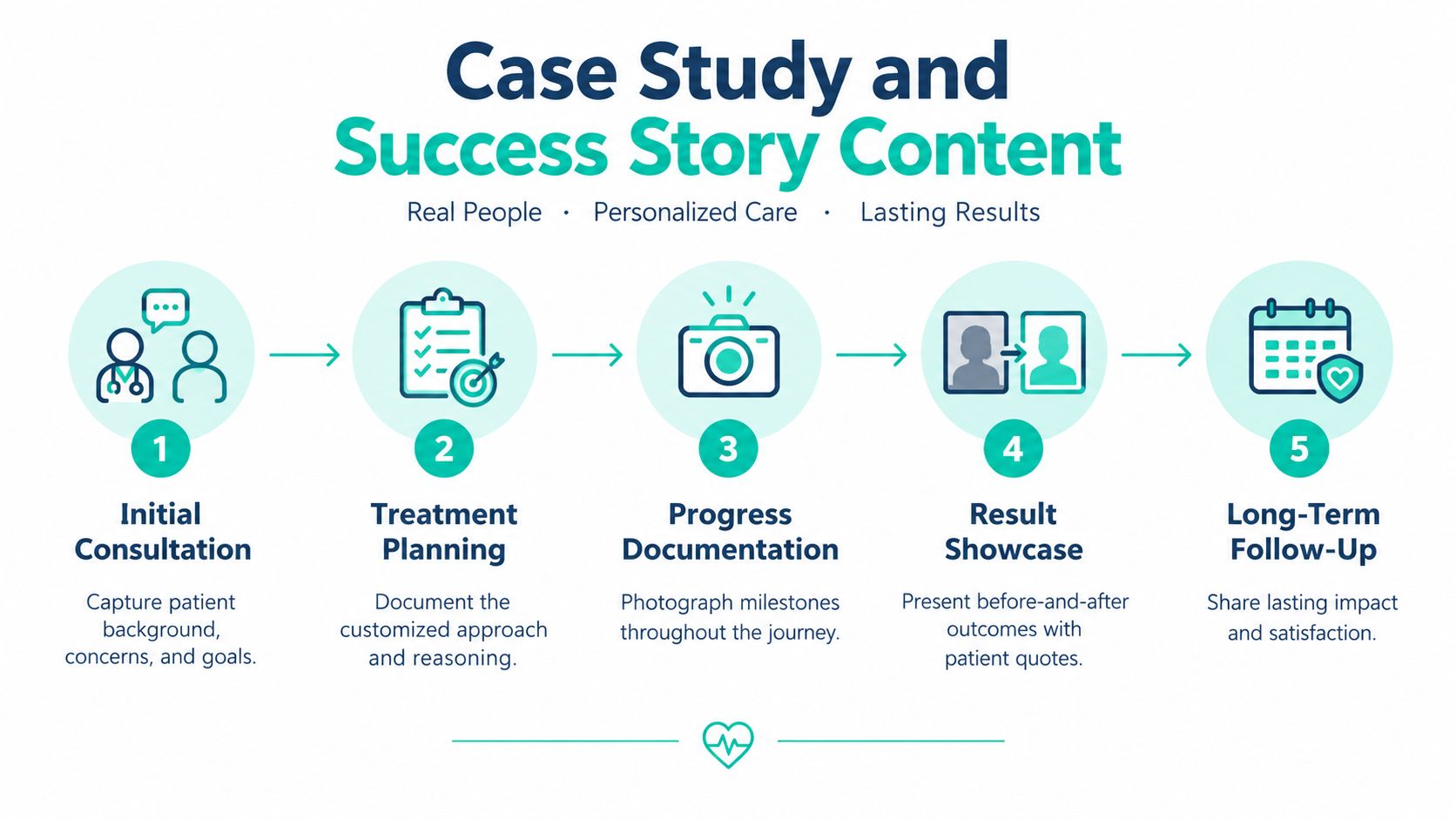
A testimonial says, “The team helped me.” A case study shows the starting problem, the decisions behind the work, and the outcome, giving a similar visitor a realistic path to consider.
Begin with the situation that prompted contact. A dental reconstruction story might describe damaged teeth, discomfort discussing treatment, why the patient chose the practice, how the team organized the plan, and what the patient valued. An orthodontic story can focus on the concerns that shaped treatment choice. A medspa can explain the client's goals, consultation process, and factors behind a treatment decision. A law firm can describe a matter's complexity and how the firm guided the client through resolution, subject to professional advertising rules.
Use copy that makes the change clear:
Before: “We provide personalized care.”
After: “After discussing discomfort and treatment concerns, the team organized a staged reconstruction plan around the patient's priorities.”
The second version gives readers something concrete to evaluate. Its CTA should match the story: “Discuss your treatment options,” “Request a consultation,” or “Ask whether this approach fits your situation.” A small business can adapt the format by documenting the customer's starting challenge, selection criteria, work completed, and practical result.
Check the story before publication. Obtain written permission and confirm whether the person wants their name, image, and details used. State outcomes accurately and with appropriate qualification. Do not imply that one result is typical, or disclose confidential health or legal information because it makes the narrative more persuasive.
Expert guidance on website case study examples recommends comparing performance before and after, including lead generation, traffic quality, conversion rate, bounce rate, and page speed where those measures are available. Apply that discipline to the page itself: record which questions it answers, which CTA it supports, and whether readers move from the story to a consultation page.
6. FAQ Pages Optimized for Search Intent and User Experience
An FAQ page should not be a dumping ground for questions no one asks. The best questions come from phone calls, emails, consultation notes, front-desk conversations, and objections that repeatedly delay a decision.
A dental FAQ might answer whether a procedure is painful, how insurance is handled, and what to do during an emergency. An eye-care FAQ can explain lens choices, technology, recovery expectations, and contact lens care. A medspa FAQ can address safety, downtime, expected timing, and whether treatments may be combined. A law firm can explain the first consultation, likely stages, costs, and what information a prospective client should gather.
Organize questions around the visitor's anxiety
Use short answers, plain language, and descriptive question headings. Group related questions so the reader can follow a decision path rather than scan an unstructured list. Link to the relevant service, pricing, contact, or booking page when the answer naturally leads there.
A useful answer might read:
Practical rule: If the same question affects whether someone books, it deserves a clear answer on the page where that decision happens.
Avoid giving a personalized diagnosis, legal conclusion, or guaranteed result in a general FAQ. Add a visible note when readers need professional advice for their specific situation. Review questions regularly as patient conversations reveal new concerns, and remove answers that no longer reflect the practice.
An FAQ can also support accessibility when it uses clear headings, readable contrast, descriptive link text, and expandable sections that work with keyboards and assistive technology. The accompanying visual can reinforce how a longer patient journey unfolds.
7. Video Content for Procedure Explainers and Introductions
Video helps visitors assess more than information. They can hear a provider explain a procedure, observe the environment, and decide whether the communication style feels comfortable. That makes it especially valuable for dental care, cosmetic treatments, vision correction, legal consultations, and any service where uncertainty causes hesitation.
A dentist might record an explanation of the Invisalign process or sedation options. An ophthalmologist can describe the stages of LASIK and the questions patients should ask. A medspa owner can explain how a consultation determines whether a treatment is appropriate. A law firm partner can introduce the firm and clarify which matters it handles.
Use real footage with a clear job
A strong video doesn't need theatrical production. It needs a focused subject, understandable audio, accurate captions, and a provider who sounds like a person rather than an advertisement. Embed the video on the service page where the question arises, not only on a separate video channel.
A simple opening could be: “If you're considering dental implants, the first appointment isn't the procedure. It's a conversation and examination that helps us understand your health, goals, and available options.”
Don't show procedures in a way that could distress viewers without warning. Get consent from anyone identifiable, avoid unsupported claims, and review healthcare, legal, and advertising requirements before publishing. Add a written summary beneath the video so visitors can scan the key information and search engines can understand the page.
“The best practice video answers one anxious question before it asks for a booking.”
A facility tour, provider introduction, and procedure explainer serve different decisions. Choose one purpose per video, then give it a CTA such as “Prepare for your consultation” or “Request an appointment.”
8. Contact and Consultation Request Pages with Clear CTAs
A contact page is not a form with the words “Get in touch” above it. It's the point where a visitor decides whether the business feels responsive, accessible, and ready to help.
A dental practice might offer online scheduling and a clickable phone number. An eye-care center can invite visitors to request a screening. A medspa can offer a consultation request that asks what the visitor wants to discuss. A law firm can let a prospective client identify the relevant practice area before sharing a brief description of the matter.
Match the CTA to the visitor's intent
Use one primary action per page and explain what happens after the visitor completes it. “Request a consultation and our team will contact you to discuss your goals” is clearer than “Submit.” If the business has different routes for appointments, emergencies, existing patients, or new enquiries, label them plainly.
Keep forms focused on the information the team needs at that stage. Don't ask visitors to disclose sensitive health or legal information through an unsecured or inappropriate form. State how the information will be used, provide a privacy link, and make alternatives visible for people who prefer to call.
Conversion rate is the percentage of visitors who complete a desired action, such as a form submission, booking, trial signup, or purchase. Website KPI guidance from G2 recommends pairing conversion data with measures such as pageviews, time on page, bounce rate, and goal completions. For a practice, that means judging a contact page by qualified calls and appointment requests, not by traffic alone.
9. Pricing and Investment Transparency Pages
Visitors often hesitate because they can't tell whether a service is financially realistic. Hiding all pricing until a consultation may protect flexibility, but it can also create distrust and attract enquiries from people whose expectations were never aligned.
A better page explains what can be shared confidently and what requires an individual assessment. A dental practice might describe the factors that affect implant or crown costs, outline financing options, and clarify what insurance questions the team can help with. An orthodontic practice can distinguish between treatment approaches without presenting a misleading universal price. A medspa can explain that investment depends on the treatment area, product, provider assessment, and desired outcome. A law firm can explain whether it uses hourly billing, retainers, contingency arrangements, or another fee structure, subject to applicable rules.
Replace price secrecy with useful context
Use language such as: “Treatment investment varies because each plan depends on the condition being treated, the materials selected, and the appointments involved. We'll explain the options and associated costs before you decide.”
Then answer:
- What changes the cost: Identify the genuine variables.
- What's included: Clarify consultations, follow-up, materials, or related services.
- How payment works: Describe accepted arrangements accurately.
- When pricing changes: Add a clear review date internally and update the page promptly.
Avoid presenting a low starting price without explaining what it excludes. Don't call an option affordable, guaranteed, or cost-effective without support. Pricing pages should reduce anxiety, not pressure people into a decision. Their best CTA is often “Discuss your options,” because the visitor needs context before choosing a service.
10. Community and Social Proof Content for Local Connection
A practice can say it cares about the community, or it can show how its people participate in one. Event coverage, local partnerships, volunteer work, charitable involvement, and educational outreach make the business feel connected to the place it serves.
A dental practice might document its support for a youth sports league and focus on the people involved rather than turning the story into an advertisement. An eye-care center can share a community screening event and explain what visitors learned. A medspa owner might support a cancer-survivor organization in a way that respects the sensitivity of the cause. A law firm can describe pro bono work or participation in legal-aid initiatives without overstating its contribution.
Make community content about people
Use real photographs, identify partners accurately, and explain why the cause aligns with the practice's values. A short story about a volunteer, coach, patient educator, or nonprofit partner often creates more trust than a generic announcement. Ask permission before naming or photographing community members, especially children and people receiving support.
A useful format is:
- Why the partnership matters: Connect the activity to a genuine value.
- Who participated: Name the team or organization with permission.
- What happened: Describe the event or contribution clearly.
- What comes next: Invite readers to learn more or participate appropriately.
Don't use charitable activity to imply clinical superiority. Don't publish donation claims that cannot be verified, and don't turn a vulnerable person's story into promotional material without informed consent. Community content works when it demonstrates consistency between the brand's stated values and its visible behavior.
Google's E-E-A-T framework describes experience, expertise, authoritativeness, and trustworthiness as important quality signals, including first-hand experience, recognized knowledge, trusted authority, accuracy, transparency, and security. Community involvement can support the trust dimension, but only when the page is specific, honest, and respectful.
Comparison of 10 Website Content Examples
| Component | 🔄 Implementation complexity | ⚡ Resource requirements | 📊 Expected outcomes | 💡 Ideal use cases | ⭐ Key advantages |
|---|---|---|---|---|---|
| About Us Pages That Build Trust and Authority | 🔄 Medium, narrative development, photo shoots, periodic updates | ⚡ Moderate, copywriting, professional photos, occasional updates | 📊 Strong credibility, better local SEO, increased patient loyalty | 💡 Practices needing differentiation and emotional connection | ⭐ Humanizes practice; builds trust and provides shareable content |
| Service/Treatment Pages Optimized for Patient Education and Conversion | 🔄 Medium–High, clinical accuracy, visuals, FAQs | ⚡ High, clinical copy, before/after galleries, HIPAA compliance | 📊 High conversion for treatment keywords; reduces decision anxiety | 💡 High‑intent treatment searches (implants, LASIK, medspa procedures) | ⭐ Directly drives bookings; answers patient questions clearly |
| Patient Testimonials and Review Showcase Content | 🔄 Low–Medium, collect, verify, and display reviews with permissions | ⚡ Moderate, review outreach, review platform management, optional video | 📊 Very high influence on acquisition; improves local SEO and trust | 💡 Trust-building for anxious/new patients and social proof campaigns | ⭐ Most persuasive social proof; low production cost for written reviews |
| Blog Content That Establishes Expertise and Drives Organic Traffic | 🔄 Medium, ongoing editorial calendar and SEO work | ⚡ Ongoing, regular content creation, SEO, occasional updates | 📊 Compounding organic traffic and authority over months | 💡 Patient education, long‑term SEO growth, thought leadership | ⭐ Low CPA over time; creates many entry points and internal links |
| Case Study and Success Story Content | 🔄 High, longitudinal documentation, storytelling, permissions | ⚡ High, time, multi‑stage photos/videos, legal/compliance review | 📊 Excellent conversion for complex/high‑investment cases | 💡 Complex procedures or high‑cost services where outcomes matter | ⭐ Detailed proof of capability; justifies higher prices |
| FAQ Pages Optimized for Search Intent and User Experience | 🔄 Low, research real patient questions and concise answers | ⚡ Low, content creation and periodic updates | 📊 Reduces admin workload; targets long‑tail search intent | 💡 Addressing common objections and onboarding questions | ⭐ Quick wins for SEO and patient self‑service; easy to maintain |
| Video Content: Procedure Explainers and Introductions | 🔄 Medium–High, scripting, filming, editing, compliance | ⚡ High, production time, editing, captions, distribution | 📊 High engagement and dwell time; significant conversion lift (20–80%) | 💡 Anxiety‑reducing content, provider intros, facility tours | ⭐ Creates strong personal connection; highly shareable and repurposable |
| Contact and Consultation Request Pages with Clear CTAs | 🔄 Low, UX design and form/booking integration | ⚡ Moderate, booking software, form optimization, automation | 📊 Direct conversion endpoint; reduces abandonment when optimized | 💡 Practices that depend on online booking and fast lead follow‑up | ⭐ Increases conversions; multiple channels accommodate preferences |
| Pricing and Investment Transparency Pages | 🔄 Medium, structuring ranges and explanatory content | ⚡ Low–Moderate, finance coordination, periodic updates | 📊 Pre‑qualifies leads; reduces price objections and surprise at consult | 💡 Higher‑investment procedures and patients researching budgets | ⭐ Builds trust; sets realistic expectations and improves lead quality |
| Community and Social Proof Content: Events, Partnerships, and Involvement | 🔄 Medium, ongoing engagement and documentation | ⚡ Moderate, event coverage, partnership coordination, content creation | 📊 Differentiation locally; stronger patient loyalty and staff attraction | 💡 Practices competing with chains or seeking local goodwill | ⭐ Demonstrates values and local commitment; drives emotional loyalty |
Turn These Examples Into a Website Content System
You don't need to rewrite every page at once. Start by mapping each important page to one visitor question and one next action. An About page might answer why the team is trustworthy and invite a visitor to meet the practice. A service page might explain whether a treatment fits the visitor's situation and invite a consultation. A case study might prove that the team can handle a complex matter and link to the relevant service.
Prioritize the formats that remove the biggest decision barrier in your niche:
- Trust-building About content for practices that feel interchangeable.
- Educational service pages for treatments or professional services that require explanation.
- Testimonials and case studies for visitors who need proof before committing.
- FAQs and pricing guidance for people delaying action because of uncertainty.
- Clear consultation CTAs for visitors who are ready but don't know how to begin.
- Community content for local businesses competing with larger, less personal brands.
Use Google's people-first guidance as a quality filter. Its helpful content guidance asks whether a satisfied visitor will learn enough to achieve their goal and whether the content demonstrates expertise, experience, authoritativeness, and trustworthiness. For health, legal, and financial topics, have the right professional review claims before publication.
A practical review should check:
- Specificity: Does the page describe this practice, team, service, and community?
- Authenticity: Does the language sound like the people who deliver the work?
- Accessibility: Can visitors scan, read, hear, and move through the content easily?
- Permissions: Do you have consent for testimonials, images, videos, and case details?
- Freshness: Are services, providers, policies, pricing, and advice still accurate?
- Internal links: Can a visitor move naturally from a question to the next relevant page?
- Conversion clarity: Is the next step visible, understandable, and appropriate to the visitor's intent?
Track outcomes rather than vanity metrics alone. A pageview can show interest, but a consultation request, call click, booking, or qualified enquiry shows whether the content helped someone act. Review the copy alongside page performance, visitor questions, and feedback from the people answering the phone.
If your practice has strong expertise but struggles to express its positioning, a strategic partner can help turn that knowledge into a connected system of pages. Leaping Lemur Media works with practices and business owners on positioning, website design and builds, CMS setup, SEO, editorial content, topic clusters, and service-focused pages that reflect the organization behind them. Its approach centers on marketing that sounds like the practice, not a generic template. You can also explore this resource on the best AI SEO agency for SaaS for a broader perspective on how content and search strategy can work together.
The most effective website content examples aren't copied from another business. They're adapted from real questions, real expertise, real client experiences, and real community relationships. Start with one page that currently creates confusion, rewrite it around one decision, and give the visitor a clear reason to continue.
Leaping Lemur Media helps practices and business owners define their positioning, build useful website pages, and create SEO content around the questions their audiences ask. Visit Leaping Lemur Media to discuss a website content system that feels like your business and guides the right visitors toward action.